
IslamiCity
Listen PodCasts, Live Quran, Watch Videos @VideoHub

In the recent 80th United Nations General Assembly, the President of the Republic of Uzbekistan Shavkat Mirziyoyev has announced the establishment of the Center for Islamic Civilization in Uzbekistan.
The soon to be officially launched unique center has the aim of preserving, studying, and promoting the intellectual, scientific, and spiritual legacies of the great intellectuals and scholars of the Muslim world. The Center is set to open in the coming months, representing a new milestone in Uzbekistan's commitment to cultural, spiritual, and scholarly revival.
Its mandate includes preserving and promoting Islamic enlightenment values and connecting the past with the present by making the heritage of classical scholars accessible to today's world.
The Center for Islamic Civilization houses manuscripts, research facilities, exhibitions, and cultural programs that highlight the contributions of Muslim scholars and thinkers such as Imam al-Bukhari, Imam al-Tirmidhi, and Imam al-Maturidi.
It is located in Tashkent, Uzbekistan, a historic crossroads of Islamic learning and civilization. The Center sits at the very heart of Central Asia, a region renowned for producing some of the greatest minds of the Muslim intellectual tradition. It is being established as an integrated scientific and educational platform.
As an integrated scientific institution, the Center preserves the thousand-year-old rich and unique heritage of people related to the Islamic faith and scholarship. It introduces the lives and scientific legacies of the great scholars and thinkers who emerged from the Uzbek land. The Center is expected to serve as a fully functioning establishment for knowledge growth, supporting fresh perspectives on Islamic civilization, particularly Central Asia's role in advancing science, philosophy, medicine, and theology.
For that, the Center will offer international scholars and researchers the opportunities for joint projects, publications, conferences, and exchange programs with universities and research institutions worldwide. They can engage with manuscripts and archives, build partnerships in heritage preservation, and contribute to global dialogue on civilization, peace, and knowledge-sharing.
In this relation, Uzbekistan also intends to hold a special presentation at the United Nations to showcase this heritage. The Center will act as a place of cultural diplomacy, strengthening relations between Uzbekistan and other nations. It will also serve as a training center for young researchers, offering scholarships and digital access to curated Islamic heritage collections.
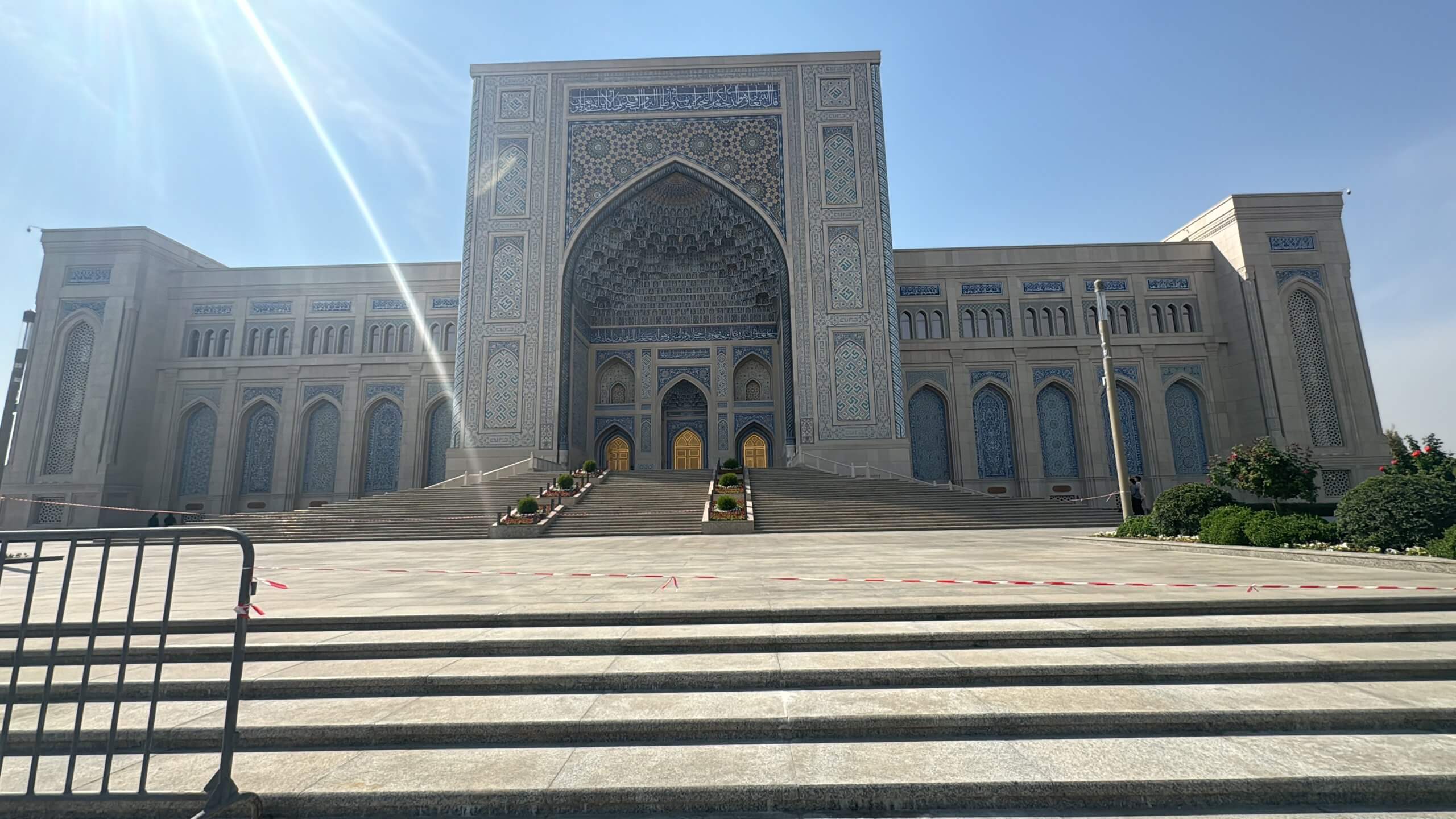
The museum in the Center will have thematic exhibition halls displaying artifacts and exhibits from the golden eras. The famous Uthman Qur'an (Osman Mushaf), written in the 7th century, will be displayed in a special glass showcase. It will be on display under the central dome, together with a collection of historical Qur'ans, manuscripts, translations, and other rare works. The Qur'an will rest on a marble-like lectern resembling the ancient stone plaque preserved in the courtyard of the Bibi Khanum Mosque in Samarkand.
One of the largest and most content-rich expositions of the museum will be the "Wall of Civilizations and Discoveries." This wall stretches for 250 meters and depicts the 3,000-year history of Uzbek statehood through bas-reliefs, miniatures, and monumental paintings. It will cover three major stages in the development of Central Asian civilization, namely, the pre-Islamic civilizations, the First Renaissance, and the Second Renaissance. Each stage will be represented in a dedicated thematic section.
As one of the Center's main goals is to engage young generations, it has developed a special museum hall for children, standing as a project implemented for the first time in Uzbekistan's history. The first floor of the museum will host several departments, including a modern restoration laboratory. Efforts are underway to include this laboratory among the leading scientific research institutions in Central Asia.
The building itself is an architectural landmark, featuring a large dome, facades, and decorative styles inspired by Timurid and madrasa architecture, as well as other remarkably beautiful designs. The Center has been designed in the magnificent style of medieval Central Asian architecture, featuring four entrance portals, one on each side. The portals and 44 exterior arches are adorned with calligraphic inscriptions containing Qur'anic verses and hadiths that convey the values of knowledge, tolerance, and humanism.
Along the perimeter of the foyer, there are 14 semi-oval arches. These arches feature mosaic-style paintings made of micro-stones, depicting the rich history of the country. Visitors will see portraits of the great figures of the First and Second Renaissances, such as Imam al-Bukhari, Ibn Sina, al-Biruni, Jalal al-Din Manguberdi, Amir Temur, Mirzo Ulugbek, Alisher Navoi, Zahiriddin Muhammad Babur, as well as Sufi scholars and Jadid reformers who shaped the nation's spiritual and intellectual legacy.
The main portal of the Center, named the Ulugbek Portal, serves as the entrance to the museum and reaches a height of 60.6 meters. The remaining three portals, located on the other sides of the building, are 28.8 meters high. The entire structure occupies a total surface area of 19,307.2 square meters, while the overall usable floor area amounts to 42,000 square meters.
On the second floor, the New Uzbekistan Innovative Library will be located. It will have 226 seats and the capacity to serve 286 people simultaneously. The library's collection is designed to hold 350,000 printed books, including 100,000 manuscripts and lithographic works, as well as 250,000 modern publications, of which 50,000 will be available in the open-access section. Its electronic collection will contain up to 5 million digital resources. The library will subscribe to international scientific and educational publications, establishing joint platforms with foreign libraries.
The Office of the Muslim Board of Uzbekistan and representative offices of international organizations including UNESCO, ISESCO, IRCICA, TURKSOY, as well as the Oxford Centre for Islamic Studies, and branches of more than 40 research institutes, museums, and libraries from Turkey, Russia, and other Central Asian countries will also be located on this floor.
The area surrounding the Islamic Civilization Centre of Uzbekistan will also include hotels, service facilities, dining complexes, and various art installations, creating a modern, comfortable, and culturally rich environment around the Center. "Civilization Gardens" inspired by the legacy of Amir Temur will be developed around the building, reflecting the aesthetic traditions of classical Central Asian landscape design. These gardens, designed in national and historical style, will be distinguished by their beauty, decorative elements, and unique structures. Various flowers and trees will be planted, recalling the ancient gardening traditions of Uzbekistan. A School of Calligraphy is also being established under the Center, with the involvement of foreign experts.
Another unique feature of the Center lies in its use of modern technology, such as audio guides, smartphone apps, immersive exhibitions, multimedia displays, and interactive museum exhibits. It is learned that visitors will also have access to an app that provides updates and push notifications about new exhibitions and events, ensuring they remain connected with the Center.
In conclusion, the Center is developed to function as a symbol of tolerance and dialogue, aligning with Uzbekistan's broader policy of peace and inter civilizational understanding. It seeks to embody noble values such as peace, humanism, friendship, mutual trust, and respect, especially for the younger generation. It will support Uzbekistan's agenda to promote Islamic enlightenment and provide facilities to study and share these values within its society and beyond. The Center is envisioned not only as a national institution but also as an international platform for dialogue, advancing common human goals.
Visitors from abroad will recognize Uzbekistan as one of the historic centers of Islamic civilization. Through a combination of research, education, exhibitions, and international cooperation, the Center will provide access to manuscripts and digital archives; host international conferences, seminars, and youth programs; collaborate with universities, research centers, and cultural institutions worldwide; and promote interfaith and intercultural dialogue in line with Uzbekistan's policy of tolerance and peace.
Shukran Abd Rahman is a Professor of Industrial and Organizational Psychology at the Department of Psychology, Abdul-Hamid Abu-Sulayman Kulliyyah of Islamic Revealed Knowledge and Human Sciences, International Islamic University Malaysia. He was a Fellow Researcher at the Imam Bukhari International Scientific Research Center in Samarkand, Uzbekistan.
Ravshan Khudayberganov is a senior researcher and associate professor at the Center for Islamic Civilization in Uzbekistan, Tashkent, Uzbekistan. His research focuses on the preservation, study, and promotion of the intellectual and spiritual heritage of classical Muslim scholars. He has been actively involved in developing scholarly collaborations and cultural initiatives that highlight Uzbekistan's role in the advancement of Islamic civilization


 Imam al-Bukhari and the Transmission of Prophetic Knowledge: The Role of th...