
IslamiCity
Listen PodCasts, Live Quran, Watch Videos @VideoHub

Sameer is a practicing Muslim who embodies the essence and spirit of Islam in the conduct of his life. Although he has endured immense suffering for two decades, he is neither suicidal nor depressed, neither bitter nor pessimistic.
His psychological health remains intact because, at every critical juncture, he sought shad beneath the tree of faith. Whenever he reached a crossroads where one path could have driven him to madness, he chose the other, guided by a flash of wisdom that saved him from collapse. Those who observe him today cannot even imagine that he has passed through the fires of hell, for he stands before them with a radiant and positive disposition.
Since most people possess only a shallow understanding of faith, they are unable to comprehend how faith can save a person from the brink of insanity. At this point, one is reminded of the great poet-philosopher, Sir Dr. Allama Muhammad Iqbal, in his monumental work The Reconstruction of Religious Thought in Islam. In the chapter titled "Is Religion Possible?", Iqbal writes:
"Religious life may be divided into three periods. These may be described as the periods of 'Faith', 'Thought' and 'Discovery'. In the first period religious life appears as a form of discipline which the individual must accept as an unconditional command without any rational understanding of the ultimate meaning and purpose of that command. In the second period, religious life seeks its foundation in a kind of metaphysics - a logically consistent view of the world with God as part of that view. In the third period, metaphysics is displaced by psychology and religious life develops the ambition to come into direct contact with the Ultimate Reality. It is here that religion becomes a matter of personal assimilation of life and power; and the individual achieves a free personality, not by releasing himself from the fetters of the law but by discovering the ultimate source of the law within the depths of his own consciousness."In this essay, the word faith refers precisely to what Iqbal calls discovery. This level of faith reduces a mountain to the weight of a dust particle. When a seeker reaches this inner altitude, he can absorb unrelenting adversity without shattering, because he perceives the meaning embedded in what he endures. The simple yet profound words of the saint Wasif Ali Wasif come to mind: "Whatever happens, it is done by Allah, and whatever He does is right." When a seeker begins to discern the wisdom behind the Divine plan, he can bear what ordinary people cannot even imagine bearing.
This is not blind faith, but a conviction arising from a deep appreciation of the divine wisdom at work. It is neither wishful thinking nor idle daydreaming. It is not a child's fantasy but the seasoned experience of one who has traversed the inner path and knows its contours. If one is fortunate enough to find a mentor who has journeyed ahead, then the seeker need not study entire libraries to grasp the path, for the companionship of a true guide is irreplaceable. The seeker begins to connect the dots of his past and present because his sight is illuminated from above. It is no wonder that the Holy Prophet (SWS) said: "Beware of the insight of the man of God; he sees with the light of God." Such insight is bestowed upon the seeker through his mentor.
Sameer's portion of adversity, pain, misfortune, and setbacks is not less than that of any other human being. Yet he lives a healthy, balanced life filled with optimism, while many others with a similar history would have drowned in despair. What distinguishes Sameer from the rest of the world? There is only one difference: Sameer did not allow his ego to obstruct the pursuit of truth. He acknowledged that there exist those deeper and wiser than himself and placed his hand in theirs, allowing them to guide his life. The rest of the world rarely does this. Their egos are enormous. They assume no one is wiser than they, and they reject the need for guidance. Consequently, they attempt to calculate life within the narrow confines of their own logic-an endeavor that leads to only two outcomes: either they fall into depression, anxiety, and stress, or they become even more bitter human beings, for their limited minds cannot offer them higher purpose or meaningful lessons.
There is no doubt that for a secular person, psychotherapy can enhance the quality of life. A therapist can navigate through a patient's emotions, thoughts, and behaviors, helping him avoid or counter negative patterns of mind and heart. No serious thinker can deny the contributions of experts in this field or their positive impact on countless individuals struggling with mental or emotional disturbance. This essay does not diminish their importance or the value of their work.
However, when a spiritual traveler endures trauma or recurrent adversity over long periods, therapy alone cannot heal him, because his worldview is shaped by God and spirituality. He needs to grasp the wisdom behind his painful experiences-an understanding that only a Shaykh or spiritual mentor can grant. Why? Because the dynamics of the spiritual path differ entirely from those of the world-seeker's path. The sciences and logics governing the latter do not-and cannot-apply to the former. Often, what appears a loss to the world-seeker is perceived as a gain by the God-seeker, and the reverse is equally true.
There is one misconception that must be dispelled. Entering Sufi training does not mean a person suddenly becomes immune to the need for medication. While the soul is elevated through the discipline of Sufism, the body continues to function like the body of any other human being. If prolonged suffering produces a chemical imbalance that manifests as negative behaviour, then he requires medication just as any Sufi would need a Disprin tablet for a severe headache. Spirituality offers additional support; it is not a magic pill that overrides the laws of biology. Thus, it is entirely possible for a Sufi to require psychiatric medication, just as a secular person might.
It is said that the higher one ascends in spirituality, the lonelier one becomes. Why? Because his scale for gain and loss grows increasingly opposite to the worldly standards promoted by bestselling authors and motivational speakers. Thus no one understands him, even though he understands them all, and this deepens his silence. It is no surprise that Sufis are frequently misunderstood by those around them, for their worldview centers on inner richness, not the accumulation of gold and silver. Their measures of success and failure stand inverted from those of ordinary people.
In the previous essay, "The Peak of Self-Effacement," it was said: "Love is both the source of pain and the balm for the wound." Indeed, the Sufi path brings unanticipated sorrows and unexpected disappointments. Why? Because lovers are always tested by the Beloved. Yet the same Sufi path contains within it pearls and diamonds of wisdom that heal every wound of the devotee. Thus, in Sufism, the fountains of both pain and pleasure are one and the same.
A secular inquisitive mind may ask: Why does the Sufi not leave this path and live a life of ease like the rest of the world? The Sufi has discovered his total dependence on God-hidden from the world-and he knows that without God he is nothing. For him, this path is not merely a matter of loyalty but one of survival. It is not a choice between living with God or without Him; it is a choice between living with God or not living at all.
Skeptics may argue that anyone can adopt a belief to feel better. How then do we know that faith is a kind of psychotherapy and not a make-believe illusion? When a person travels the spiritual path under the guidance of a genuine mentor, the harshest events of life begin to shine with meaning, revealing a light at the end of the tunnel. This light is not a fabricated comfort invented by the mentor; it is affirmed by more than a thousand years of Sufi tradition, in which thousands of seekers have traversed this path and witnessed similar truths. One cannot dismiss the collective life-experiences of so many noble men and women as delusion. A delusion cannot offer solace to countless seekers across centuries.
Just as secular psychotherapists possess data about human behavior validated by numerous cases, Sufi masters possess a treasury of wisdom validated by the experiences of innumerable travelers. Yet, under the dominance of Western paradigms, we revere material sciences while disregarding the scientists of the inner world simply because they hold no formal degrees. This is a matter of bias, not truth; of prejudice, not inquiry; of ignorance, not learning; of superficiality, not depth.
A serious student might ask: Conceptually, what is the fundamental difference between secular psychotherapy and Sufi training? There is one primary distinction from which hundreds of others emerge. For the therapist, the human being consists only of mind and body, and the battle is confined to these two. For the Sufi, two more entities are involved: the soul and the lower-self (nafs)-and the battle is four-sided. The therapist guides according to what is known about mind and body. The Sufi guides in a manner that allows the soul to triumph over mind, body, and the lower-self (nafs). This is why many people have confessed that they were saved from suicide solely by the companionship and writings of Wasif Ali Wasif, who offered neither medication nor counselling sessions.
Secular psychotherapy encourages gratitude to cultivate a positive mindset, but a secular person usually expresses gratitude only when his desires are fulfilled. Yet the fabric of life is such that most people never see their desires realized in this fleeting existence. A seeker who enters the discipline of Sufi training learns to offer gratitude even when none of his desires are fulfilled, because for him the Divine plan outweighs every personal plan. In the beginning, this may be only an act of belief for a novice, but as he grows in spiritual maturity, he begins to perceive the wisdom hidden within shattered dreams and broken hopes. What was once an exercise in patience gradually transforms into an act of thankfulness. This profound shift becomes possible only because a change of heart is far more life-transforming than a mere change of opinion.
Very few thinkers have recognized the direct relationship between ego and psychological distress. The larger the ego, the more complicated the personality becomes-and the greater the mental imbalance. The smaller the ego, the simpler the person-and the fewer the psychological ailments. Let me illustrate this with a universally acknowledged example.
The fourth caliph of Islam, Hazrat Ali (RZA), was among the greatest minds in history, yet he lived with astonishing simplicity. He stitched his own clothes, mended his own shoes, carried sacks of food on his back in the silence of night to feed widows and orphans, and refused every privilege that came with political power. Why? Because he had conquered his ego. Today, if a university graduate were placed in a situation demanding even a fraction of such humility, he would struggle to sleep without medication. Although we cannot attain the humility of Ali (RZA), we can strive toward it through Sufi training. A therapist, however, cannot teach humility; it lies outside the scope of his work. His methods can bring only cosmetic changes to the patient's personality.
Although any sane human would choose happiness over grief-and rightly so-not every virtue that leads to greatness is born from happiness. Even secular thinkers say that adversity is the school of greatness. Their definition is different, for they measure greatness by how history ranks a person's achievements.
In the spiritual realm, this saying is even truer, for many of our false beliefs about life and ourselves are shattered by a single adversity rather than a hundred lectures. Since the entire endeavor of self-realization seeks gnosis (ma'rifah) of God, any experience-no matter how painful-that removes the veils between the seeker and God is worth enduring.
To a secular mind, it seems unreasonable that God would place a human being in a crucible merely to teach a lesson. But the truth is that the self-worshipping tendencies of the human heart often break only within the crucible. Anything that draws us closer to God is success; anything that distances us from Him is failure. In both cases, worldly gain or loss carries no ultimate value, for the truest worth of every phenomenon is the worth assigned to it by the Creator.
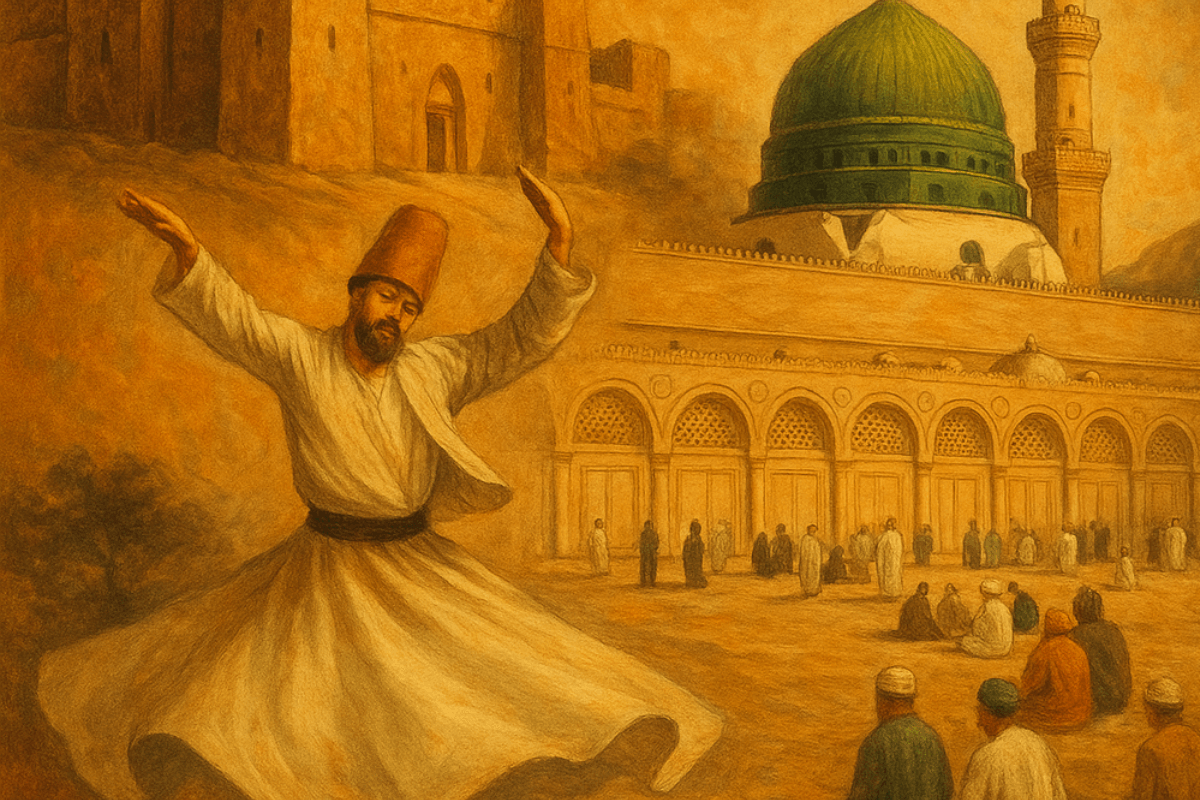
Little wonder that Rumi, sage of East and West, said: "The wound is where the light enters." Countless people in the world possess the potential to become a Sameer, yet they never become one because they do not allow the light to enter their wounds. Why? Because desire blinds them so thoroughly that any teaching requiring them to relinquish a desire feels "preachy" or "judgmental." Sameer relinquished his desires only because he was shown a higher purpose, a grander definition of life, a deeper mystery unveiled, a hidden secret revealed by a master, a taste of love unknown before, a spirit of selflessness never awakened, a ray of hope never witnessed, a touch of divinity never felt.
If a scholar of Rumi's stature needed a Shams in his life, how can an ordinary person of today imagine he needs none?
 The Two Models of Islam


