
IslamiCity
Listen PodCasts, Live Quran, Watch Videos @VideoHub

Universities exist to transform individuals into capable, responsible contributors serving as intellectuals, scholars, and professionals who strengthen the workforce, generate knowledge, and drive societal progress.
A key moment in this transformative journey is the convocation ceremony, which formally recognizes the culmination of students' academic efforts and their readiness to assume these societal roles. The university convocation ceremony stands as one of the most enduring, meaningful, and symbolically rich traditions in higher education.
More than a ceremonial gathering, convocation embodies the identity, legitimacy, and social purpose of a university (Brubacher & Rudy, 2008). It is a moment where academic achievement, institutional heritage, cultural tradition, and societal expectations converge.
Today, modern convocation ceremonies have matured into major academic events, multimedia-rich, globally broadcast, and attended by national leaders, distinguished scholars, and families from around the world. This expansion reflects not only institutional maturity but also the broadening societal impact of higher education.
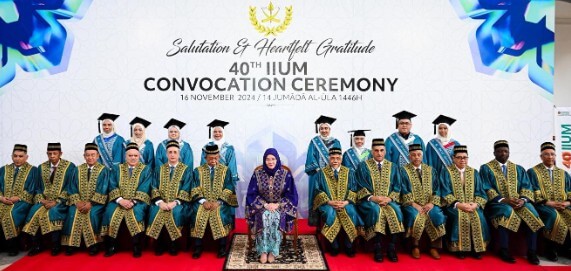
Although modern attire has changed to the square board, the symbolism remains, in that graduands bear the honor and responsibility of knowledge. Academic robes also trace their origins to Islamic centers of learning, where they signified recognition of scholarly competence and the duty to disseminate knowledge responsibly (Ashraf Ihsraqi Jamil, 2019).
A convocation becomes noble when it upholds dignity, tradition, and the symbolic weight of knowledge. The ceremonial rituals, academic robes, mortar boards, formal procession, awarding of degrees, and final charge from top University officials imbue the event with meaning. The presence of families, academics and institutional leaders reinforces communal support and respect. Most importantly, the ceremony's focus on intellectual, ethical, and societal responsibilities ensures that it transcends mere celebration to become a moral and cultural milestone.
The event affirms the validity of academic awards, recognizes years of student effort, strengthens institutional heritage, sustains societal trust in higher education, and articulates expectations for graduates as future contributors to society. In some contexts, convocation carries significant importance, as it enhances the university's reputation, builds public confidence, and strengthens recognition of graduates' achievements. It also serves as a vital platform to convey institutional values and uphold societal commitments.
Convocation, ultimately, is a social contract in which the university confers recognition and entrusts its graduates with responsibility, integrity, and service.
Today, convocation broadly refers to the gathering of scholars in an academic assembly to celebrate the completion of undergraduate and postgraduate studies. This assembly honours the exalted status of knowledge, during which graduands receive their degrees as a testament to their scholarly journey and the knowledge they have acquired.
In a ceremony conducted with full formality, graduands receive a final charge from university leadership, highlighting their responsibilities toward knowledge, the trust they bear as scholars, and the roles they are expected to play in society. The academic headgear worn symbolizes the intellectual stature of the degree recipients, who are entrusted with disseminating the knowledge they have mastered and upholding responsibility for it.
The convocation ceremony is made even more meaningful by the presence of students' parents, who, from the moment of their children's birth, have provided unwavering support, including guiding and enabling them to pursue higher education.
The Master's Degree represents advanced expertise, analytical capability, and readiness for leadership or specialized roles. It indicates the graduates' preparedness to contribute strategically to society, supported by research literacy and advanced problem-solving skills (Council of Graduate Schools, 2020).
Doctor of Philosophy (PhD) degree is the pinnacle of academic attainment. It symbolizes the transition from knowledge consumer to knowledge creator. A PhD graduate demonstrates intellectual independence, produces original research, and provides thought leadership within academia and society (Boud & Lee, 2009).

Many convocation ceremonies also confer Emeritus (male) or Emerita (female) Professor titles, honoring retired academics whose careers reflect sustained excellence in teaching, research, institutional development, and community service (Altbach, 2015). For the institution, these titles preserve intellectual heritage, affirm academic excellence, and strengthen identity. For society, Emeritus and Emerita Professors remain public intellectuals, mentoring young scholars, advancing knowledge, and contributing to national development.
Besides the above, some universities confer honorary doctorates to extraordinary non-academic figures who have made significant contributions to society, culture, science, or humanitarian causes. These awards recognize exceptional achievements, inspire others, strengthen institutional prestige, and highlight the university's commitment to excellence, service, and societal impact beyond conventional academic accomplishments.
A convocation ceremony should avoid elements that distract from its scholarly and ethical significance. Excessive commercialization, unrelated performances, informal activities, inappropriate attire, or any behavior that diminishes decorum should be excluded. The emphasis must remain on recognizing graduands' intellectual and ethical accomplishments.
The sanctity of convocation is compromised when the focus shifts from scholarship and responsibility to the inclusion of irrelevant activities, entertainment, or disregard for decorum, and when there is lack of preparation, trivialization of academic achievements, or any factor that diminishes the event's solemnity. Besides, failing to emphasize graduates' ethical and societal responsibilities during the ceremony undermines the ceremony's purpose, reducing it to a hollow formality.
In short, convocation is far more than a ceremony. It is a profound academic rite of passage that honors achievement, validates competence, preserves university heritage, and communicates expectations for ethical and meaningful contribution. For graduates, it marks the start of a lifelong journey guided by the knowledge they have gained and the responsibilities they now bear.
Shukran Abd Rahman is a Professor of Industrial and Organizational Psychology at the Department of Psychology, AbdulHamid AbuSulayman Kulliyyah of Islamic Revealed Knowledge and Human Sciences, International Islamic University Malaysia.


 From Job Competencies to Humanity-Centric Education: A New Imperative for T...