Prophet David (whose name is mentioned 16 times in the Qur'an) is one of the very few Islamic Prophets who received Kingship as well as Prophethood. In the Quran, David (Dāwūd) is a revered prophet and righteous king known for defeating Goliath, receiving the holy book Zabur (Psalms), and being gifted with wisdom, a beautiful voice for glorifying God, and the ability to shape iron; he is often mentioned with his son Prophet Solomon as a model of faith and justice, with Muslims viewing David as a flawless prophet.
One of the most obvious differences between the Hebrew Bible and the Qur'an is the extensive use of anthropomorphisms and metaphors in the Hebrew Bible and their rare use in the Qur'an.
I can use examples from a wonderful essay about anthropomorphisms and metaphors by Reform Rabbi Andrea L. Weiss, a Professor of Bible at the Hebrew Union College-Jewish Institute of Religion in New York, in order to explain Biblical anthropomorphisms and metaphors to Muslims who are accustomed the the beautiful but de-anthropomorphic style of the Qur'an. Muslims will see that many of the 99 names of Allah provide a more disembodied language for similar descriptions of God'a attributes.
Rabbi Andrea Weiss says that at the heart of Torah Deuteronomy 32 there is "the Song of Moses") which uses many different metaphors for God. In just fifteen verses (32: 4-18), we find metaphors of God as a rock, a father, an eagle, and a mother. These metaphors teach us about the Torah's perception of God's multifaceted nature in general; and God's complex relationship with the People of Israel in particular; about how metaphor works in the Hebrew Bible, and how God's greatest Prophets were sometimes guilty of many human sins.
Conservative Rabbi David Wolpe points out, in an article in The Times Of Israel, that several shows about King David are now streaming. There is an animated film, a forthcoming docudrama and a streaming TV show. Why the sudden surge of interest in the ancient Israelite king?
Zachary Levi, the actor tapped to star in the Fox Nation docudrama "David: King of Israel" set to launch in March, explained his interest in David in a statement: "Aside from the account of Christ, the story of David is the most powerful in all of scripture. In fact, one might argue that it's even more powerful in some ways, given that David was fully human, and therefore flawed, like us, making his journey more relatable to our own."
And about the massively popular "House of David," whose second season is soon to start streaming on Amazon, the Jewish consultant brought in to assist the evangelical show runners had a simple take. "King David is someone who can inspire anybody," Jenn Levine told the Jewish Telegraphic Agency last year, in an unpublished interview.
Indeed, while the three major David productions all emerge from the recent explosion in Christian programming, I believe Jews would do well to tap into the David moment, too.
In the Hebrew Bible the story of David is one of a flawed but supremely gifted and determined person who rises to the pinnacle of leadership. He is an improbable hero. But once tested, his remarkable courage is inspiring precisely because he is otherwise so unprepossessing.
The slingshot that fells Goliath epitomizes not only the improbability of David's victory, but its creativity and daring. How desperately we seek that in leaders today: someone who will step forward when others are afraid and do difficult things with elan and grace.
Prophet David also models different human qualities and their coexistence in one heroic figure. He is a sensitive soul, who plays music and writes poetry; yet on the battlefield he is fierce and his band of fighters are loyal to him. The name David means "beloved," and no character in the Bible is said to have been loved as deeply as David: he is loved by Saul, by Michal, by Jonathan, by Israel and by God. In an age eager for both, David displays both strength and tenderness.
Also, and crucially to the David story, he sins. David is a deeply flawed human being. He has trouble with his children - his own son, Absalom, rebels against him - and does not stride frictionless through life. But it is his sin with Bathsheba that determines much of what we think about this remarkable figure.
To remind us of the story: David sees Bathsheba bathing on an adjoining roof. He desires her, summons her and sleeps with her. When he discovers that she is pregnant, he summons her husband Uriah back from combat to induce him to sleep with his wife. When Uriah refuses to do so, for he feels it is dishonorable when his compatriots are fighting on the front lines, David arranges to have him killed in battle. So he has committed, all in one episode, both adultery and murder.
In a time of tension, how should the Jewish community react to Christian depictions of David? Remembering his role as the founder of Jerusalem, and therefore as pivotal in Israel's historic ties to the land, we should certainly welcome the framing of David as a heroic if flawed figure.
Rabbi Wolpe writes that while David as "prelude" is part of the Christian story, and may raise theological differences, I know from speaking about David in churches and Christian colleges that a common celebration of his legacy is more a tie than his eschatological status is a divider.
What about this story would appeal to the contemporary viewer? Not only the salacious reality of the story itself, but the astonishing aftermath. In the ancient world, kings had plenipotentiary power, meaning they could do whatever they wished. David's actions could be multiplied a thousandfold in the ancient world with no consequences for the kings who murdered their rivals, stole their women, violated their people in countless ways, all with impunity.
Yet when Prophet Nathan daringly accused King David of his crime, what astonishes is what King David did not do; he didn't say, "Off with his head!" Instead, David instantly recognized his sin, fell to weeping before God and begged for repentance. Power does not merely reveal character; it tests whether we can repent of the selves power tempts us to become.
In this juxtaposition is the deepest appeal of David to the modern audience. He is a model of masculinity and heroism that does not deny the ugly side of those roles: The hero is often one who slays more efficiently and the man is often the one who prosecutes his will at the expense of his conscience. But the true man, and the true hero, is not only an external quality - not merely one who acts.
He is one who feels, regrets, understands, embraces his friends, dances and weeps. David exemplifies depth and offers accountability, which is a balm in an unaccountable age. He reminds us that greatness is not the absence of failure but the refusal to let failure be the final word.
Finally, Prophet David carries within himself the relation of politics to art and to faith. In an idolatrous world, Prophet David is true to the God of Israel. In a savage time, he is a spinner of songs and poetry. He shows that the same hand that wields the sword can also pluck the harp.
There are many speculations about why David is the one chosen to be the precursor of the Messiah. In my book I review some of the theories, but in the end, I believe the key is when God says that David is "a man after my own heart." Since everything is in God, the more fully human one is, the more one in a sense carries out the religious injunction of imitatio Dei, to conduct one's life b'tzelem Elokhim - in the image of God. Holiness is not a flight from humanity, but its fullest realization.
The Qur'an teaches: Say, [O believers], "We believed in Allah and what has been revealed to us [the Qur'an] and what has been revealed to Abraham and Ishmael and Isaac and Jacob and the Descendants [of Jacob] and what was given to Moses (the Torah) and Jesus (the Gospels) and what was given to the (other) prophets from their Lord. We make no distinction between any of them, and we are Muslims [in submission] to Him."
(Qur'an 2:136)

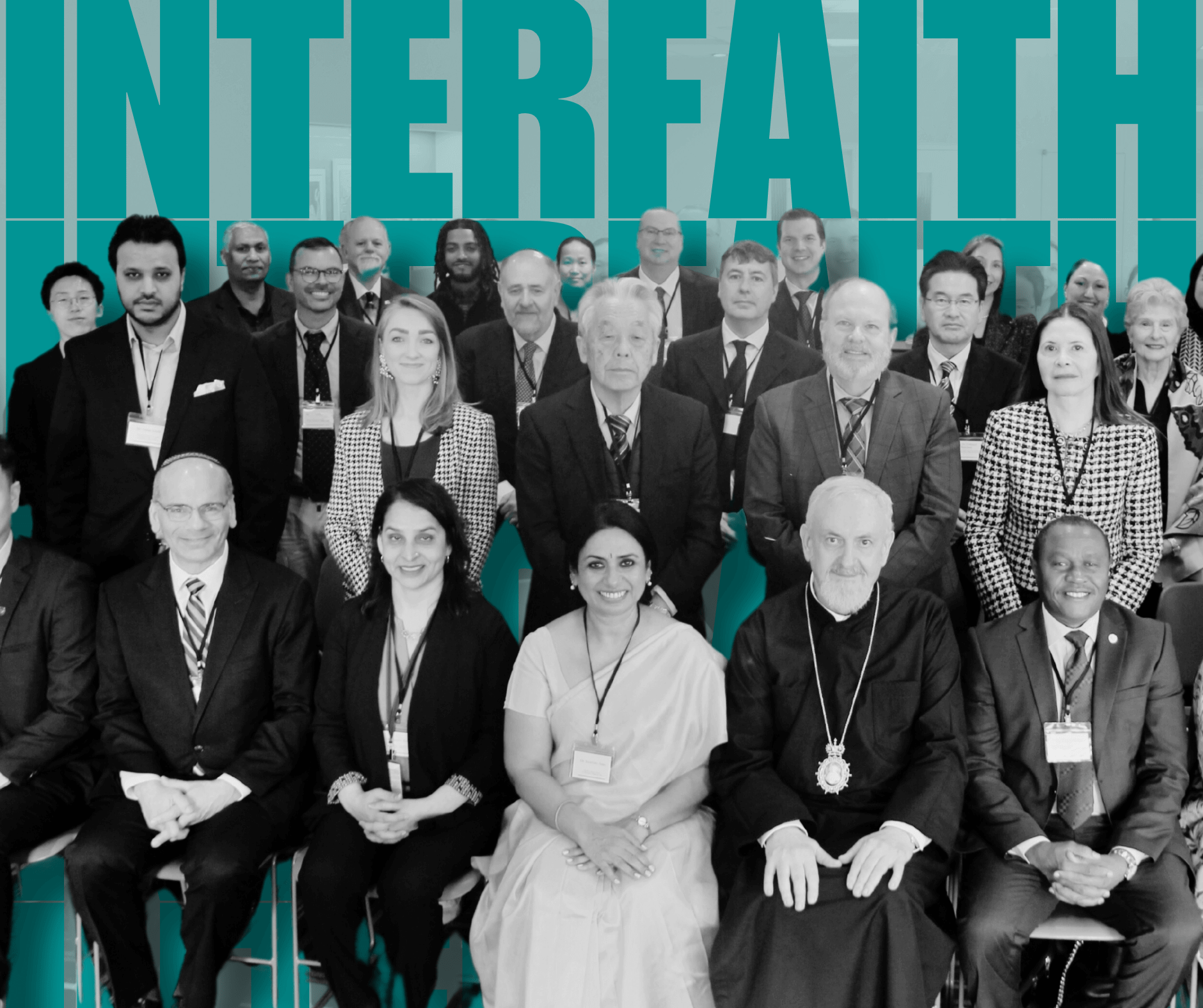 Dr. Sayyid Syeed: A Pillar of Interfaith


