
IslamiCity
Listen PodCasts, Live Quran, Watch Videos @VideoHub

The rapid development of artificial intelligence (AI) has revived one of the oldest questions in intellectual history: what does it mean to be human? As machines increasingly perform tasks once associated with human cognition-calculation, pattern recognition, language production, and even creative imitation-the temptation arises to blur the distinction between human intelligence and artificial intelligence.
Yet this temptation carries serious philosophical, moral, and civilizational risks. A careful examination reveals that while AI can meaningfully enhance human intellectual activity, it does not-and cannot-replace the essential features of human intelligence. The relationship between the two is best understood not in terms of rivalry or equivalence, but of complementarity grounded in a clear recognition of human dignity.
This essay articulates the fundamental differences between human intelligence and artificial intelligence, then explains how AI, when properly situated, can enhance human intelligence in the pursuit of knowledge.
The Nature of Human Intelligence
Human intelligence is not merely computational. Across philosophical and religious traditions, it is understood as a multi-layered faculty that integrates reason, moral judgment, intentionality, and responsibility.
First, human intelligence is conscious and self-reflective. Humans are aware not only of objects of thought, but of themselves as thinkers. This reflexivity allows for doubt, moral struggle, repentance, and growth-capacities inseparable from personal identity.
Second, human intelligence is morally situated. Humans do not merely know; they care. Knowledge is filtered through conscience, emotion, empathy, and ethical evaluation. Classical traditions locate this capacity not solely in the brain but in what is often called the heart-the seat of intention, sincerity, and moral perception. Intelligence, in this sense, includes the ability to recognize truth as binding, not merely as information.
Third, human intelligence involves intentional agency. Humans choose goals, revise them, and take responsibility for consequences. Even when mistaken, they remain accountable. This capacity for moral responsibility distinguishes human reasoning from mechanical output.
Finally, human intelligence is existentially embedded. It is shaped by lived experience, historical memory, cultural tradition, suffering, hope, and transcendence. Knowledge is not detached from life; it is woven into it. These characteristics together form an understanding of intelligence that cannot be reduced to information processing alone.
The Nature of Artificial Intelligence
Artificial intelligence operates on fundamentally different principles. AI systems process symbols, identify patterns, and generate outputs based on statistical relationships within data. They do not possess awareness, intention, or moral agency.
AI has no consciousness or inner life. It does not experience meaning, doubt, conviction, or moral weight. Any appearance of understanding is the result of simulation, not participation. AI produces responses without comprehension in the human sense, just as a mirror reflects an image without seeing it.
Moreover, AI lacks intentionality. It does not choose goals or values; these are always supplied externally by human designers, institutions, or users. Consequently, AI cannot be morally responsible for its outputs. Responsibility lies entirely with the humans who design, deploy, and interpret it.
AI is also derivative by nature. It does not generate knowledge from lived experience or existential engagement. Instead, it recombines and extrapolates from existing human-produced data. Even its apparent creativity is a sophisticated form of recombination rather than original insight rooted in moral or existential risk.
In short, artificial intelligence is best understood as a tool of cognition, not a bearer of intelligence in the full human sense.
Why the Distinction Matters
Confusing artificial intelligence with human intelligence leads to serious consequences. When intelligence is reduced to computation, humans themselves are reimagined as machines-interchangeable, optimizable, and morally expendable. This reduction erodes concepts such as dignity, responsibility, and justice.
Civilizations that lose sight of the moral and spiritual dimensions of intelligence risk replacing ethical judgment with technical efficiency and substituting power for truth. AI, if treated as an authority rather than an instrument, can amplify existing injustices rather than correct them.
Maintaining a clear distinction, therefore, is not an exercise in technological pessimism. It is a defense of human uniqueness and moral accountability.
How Artificial Intelligence Can Enhance Human Intelligence
When properly understood and ethically governed, artificial intelligence can significantly enhance human intellectual life. Its contribution lies not in replacing the human mind or heart, but in supporting human inquiry.
The Proper Relationship: Instrument, Not Authority
The most constructive relationship between human intelligence and artificial intelligence is one of instrumental support. AI should be treated as a powerful extension of human cognitive tools-like writing, printing, or computation-but never as a substitute for conscience, wisdom, or responsibility.
Human intelligence, grounded in consciousness and moral accountability, must remain the judge of meaning and purpose. Artificial intelligence, lacking a heart and moral agency, can assist only insofar as it is guided by human values.
Artificial intelligence marks a significant moment in human intellectual history, but it does not alter the fundamental nature of human intelligence. Humans remain distinguished by consciousness, moral perception, intentionality, and responsibility-qualities that no machine can possess.
Properly understood, AI can enhance human intelligence by expanding access to knowledge, sharpening reasoning, and supporting education and dialogue. Improperly understood, it risks reducing humans to machines and elevating tools into false authorities.
The task before contemporary civilization is therefore not to ask whether machines can think like humans, but whether humans will continue to think-and judge-with wisdom, conscience, and moral clarity. Artificial intelligence can assist in the pursuit of knowledge, but only human intelligence, guided by the heart as well as the mind, can determine what that knowledge is for.
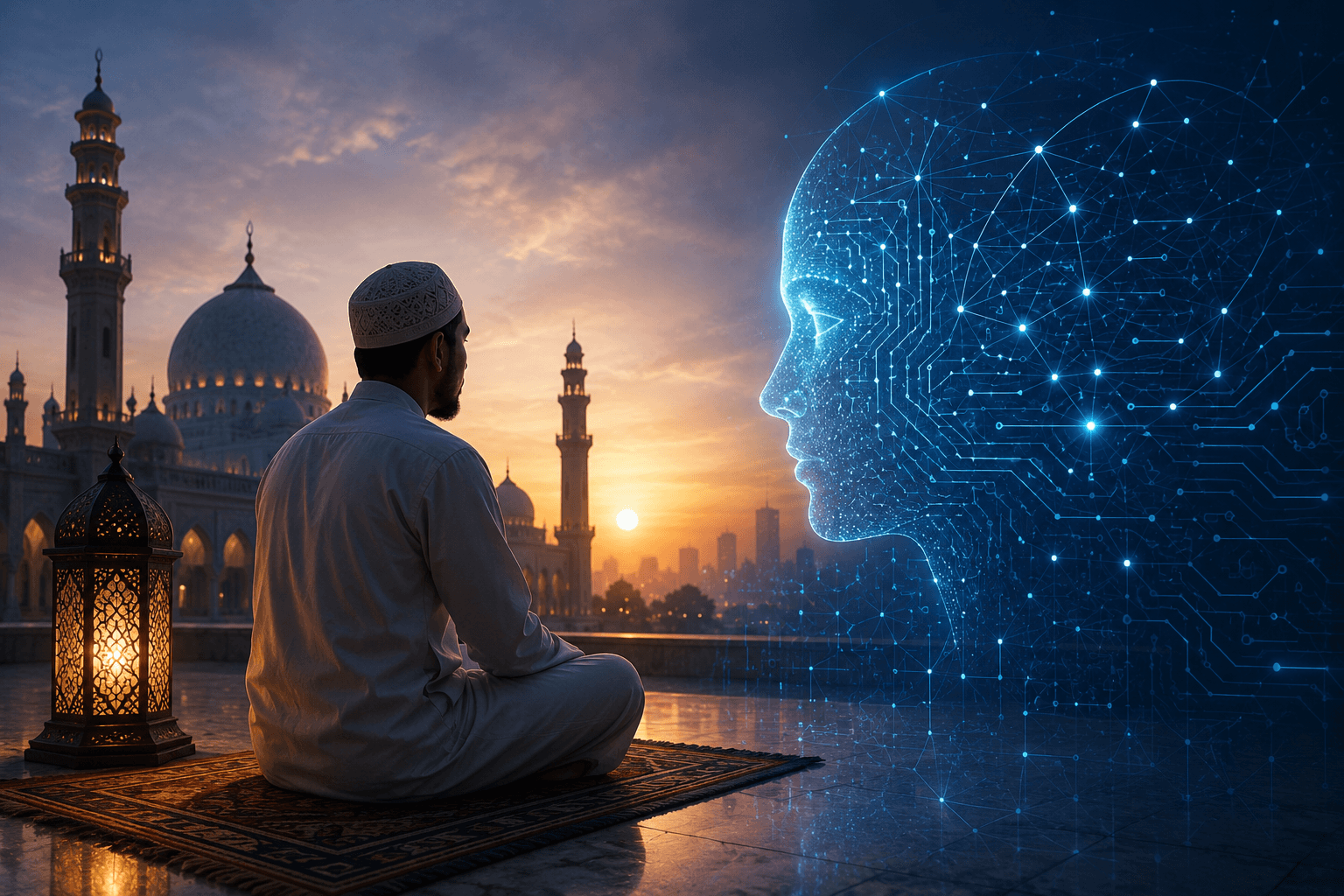 AI, Faith, and the Future: Understanding Islam's Perspective


