
IslamiCity
Listen PodCasts, Live Quran, Watch Videos @VideoHub

We are living in a time of unprecedented technological advancement. Artificial Intelligence, commonly known as AI, is no longer a concept from science fiction movies. It has become part of our daily lives.
Many of us use AI without even realising it. It helps us navigate traffic, suggests what to watch, assists with online shopping, and even answers our questions in seconds. AI can write articles, generate images, organise schedules, and support businesses.
As this technology becomes more powerful, many Muslims are asking an important question:
Can Muslims use AI?
The answer is not as simple as yes or no. Like many modern issues, Islam encourages us to look beyond the surface and examine the purpose, impact, and ethics behind our actions.
Islam does not oppose innovation or technological progress.
Throughout history, Muslims have embraced tools that improved society. From advancements in medicine and astronomy to the preservation of knowledge through writing and printing, Islam has never been a religion that fears beneficial progress.
The key principle is that technology itself is usually neutral.
A smartphone can be used to listen to the Qur'an or to consume harmful content.
Social media can be used to spread beneficial reminders or harmful gossip.
Likewise, AI can be used for good or bad.
Allah says:
"And cooperate in righteousness and piety, but do not cooperate in sin and aggression."
This verse provides a framework for understanding AI. If it is used in ways that benefit humanity, increase knowledge, and support good actions, it can be a valuable tool. If it is used for deception, exploitation, or harm, then it becomes problematic.
One of the most famous hadith in Islam states:
"Actions are judged by intentions."
(Sahih al-Bukhari)
This principle applies to technology as much as it applies to worship.
A student may use AI to better understand a difficult topic.
A business owner may use it to improve efficiency.
A teacher may use it to prepare educational resources.
A writer may use it to organise ideas.
In these situations, AI serves as a tool to support beneficial goals.
However, if someone uses AI to cheat, spread misinformation, plagiarise work, or manipulate others, then the issue is not the technology itself but the intention and action behind its use.
Muslims should always ask themselves:
Why am I using this tool?
Is it helping me fulfil my responsibilities or avoid them?
One of the most common concerns among Muslims is whether AI can be used to learn Islam.
AI can certainly help people access information quickly. It can summarise topics, explain concepts, and direct users toward resources.
However, Muslims should be careful not to treat AI as a substitute for qualified scholars.
Islamic knowledge requires understanding context, language, jurisprudence, scholarly consensus, and wisdom. AI can sometimes provide inaccurate or incomplete information.
Allah says:
"Ask the people of knowledge if you do not know."
This verse reminds us that authentic Islamic guidance should come from knowledgeable and trustworthy scholars.
AI may assist learning, but it cannot replace scholarship.
When it comes to important matters of faith, worship, marriage, finance, or Islamic rulings, Muslims should seek guidance from qualified scholars rather than relying solely on artificial intelligence.
Perhaps one of the greatest concerns surrounding AI is not misinformation but dependency.
Today, people increasingly turn to technology for every question, decision, and problem.
What should I wear?
What should I study?
What should I eat?
What should I do with my life?
AI can provide suggestions, but there is a danger in becoming so reliant on technology that we stop reflecting for ourselves.
The Qur'an repeatedly calls believers to think, reflect, and contemplate.
Allah asks:
"Do they not reflect?"
Reflection is an essential part of faith.
Critical thinking, self-awareness, and contemplation are gifts from Allah. Muslims should use AI as a support tool, not as a replacement for the intellect Allah has blessed them with.
One of the most remarkable features of AI is its ability to process vast amounts of information.
It can answer questions within seconds.
It can generate essays, reports, and ideas.
Yet despite its capabilities, there are things AI can never do.
It cannot experience sincerity.
It cannot feel gratitude.
It cannot make dua.
It cannot develop taqwa.
It cannot cry during tahajjud.
It cannot experience the peace that comes from remembering Allah.
The Prophet Muhammad, peace be upon him, said:
"There is a piece of flesh in the body; if it is sound, the whole body is sound. If it is corrupted, the whole body is corrupted. Truly, it is the heart."
(Sahih al-Bukhari and Sahih Muslim)
The heart remains at the centre of a believer's journey.
Technology can provide information, but it cannot purify the soul.
Only a sincere relationship with Allah can do that.
The challenge facing Muslims today is not whether technology exists.
The challenge is learning how to engage with it wisely.
We live in a culture that celebrates speed, convenience, and efficiency. AI promises faster answers and quicker results.
But some of the most important aspects of faith cannot be rushed.
Patience takes time.
Character development takes time.
Healing takes time.
Building trust in Allah takes time.
Spiritual growth remains a deeply human journey.
As Muslims, we should welcome beneficial advancements while remaining mindful of our values.
We should use technology without allowing it to control us.
We should embrace innovation without compromising our principles.
And above all, we should remember our purpose.
Allah says:
"And I did not create jinn and mankind except to worship Me."
No matter how advanced technology becomes, this purpose remains unchanged.
So, can Muslims use AI?
Yes-provided it is used ethically, responsibly, and in ways that align with Islamic values.
AI can be a powerful tool for learning, productivity, and beneficial work. However, it should never replace sincere worship, personal reflection, or the guidance of qualified scholars.
As we navigate this rapidly changing world, we must remember that while technology can make life easier, it cannot provide the ultimate guidance our hearts seek.
AI may answer questions.
But only Allah can guide souls.
May Allah grant us wisdom to benefit from what is useful, avoid what is harmful, and remain steadfast in our faith regardless of how much the world around us changes.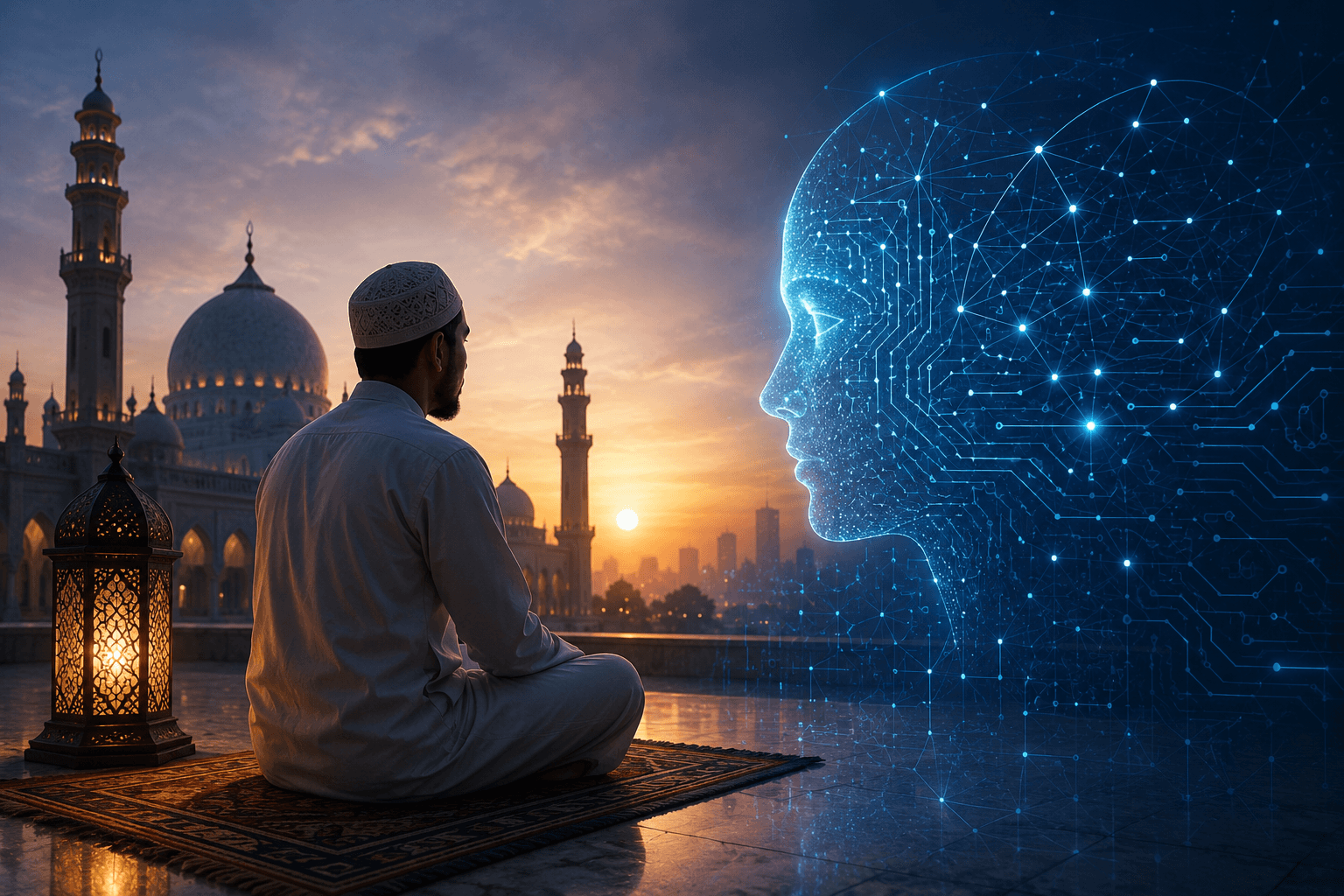 AI, Faith, and the Future: Understanding Islam's Perspective


