
IslamiCity
Listen PodCasts, Live Quran, Watch Videos @VideoHub

The conversion of Hagia Sophia (Holy Wisdom, in Turkish, Ayasofya) into a mosque in Istanbul (formerly Constantinople) should not be understood merely through the narrow lens of religious triumphalism or sectarian hostility.
Such an interpretation oversimplifies one of history's most consequential civilizational transformations. The decision carried practical, political, religious, and symbolic dimensions, all of which must be appreciated together. To disregard any of those dimensions would unavoidably result in proportional distortions and a reductionist view of history.
From a practical perspective, Constantinople had suffered a long period of demographic and economic decline before its conquest (fath, meaning opening and liberation) in 1453. Its population had dwindled dramatically from the hundreds of thousands that had once inhabited the imperial capital. Numerous churches stood abandoned or were only sparsely attended. The remaining Christian inhabitants neither required nor could effectively maintain the vast number of ecclesiastical buildings inherited from the Byzantine past.
Vast areas of the city fell into ruin as a result. Travelers in the 14th-15th centuries described empty districts, abandoned and collapsed buildings, and growing farmland in the heart of the city walls. Undeniably, the infrastructure built for half a million people became unsustainable for a population reduced to only tens of thousands. Hagia Sophia was also badly affected, so much so that only its dome remained in an admirable state.
The city, on the eve of the conquest, was literally dying. As paradoxical as it may seem, the arrival of the Muslims may well have saved it, offering both the city and all those associated with it renewed hope for a better future. That Constantinople eventually became a cosmopolitan oasis of peace, tolerance, and coexistence - while at the same time serving as the welcoming capital of faith, civilization, and the wider world, where Christians, Jews, and many other communities flourished alongside the Muslim majority - testifies to this transformation. The Jews, in particular, described the Ottoman capital as a paradise for their communities.
Hence, it is hardly surprising that, immediately after the conquest, an urgent effort was undertaken to repopulate the city with the empire's diverse religious and ethnic communities, thereby transmuting it into a microcosm of the Ottoman world. So urgent was the matter that, beyond various incentives, some people were even compelled to migrate to the new capital. This was essential not only for the city's revival and prosperity but also for preventing its complete demise. In passing, after the death of Sultan Mehmed II in 1481, 28 years after the conquest, the city had already grown to around 100,000 inhabitants, of whom approximately 60-80,000 were newly arrived settlers.
Nor was Hagia Sophia chosen simply because it was the largest church in the city. Its significance was far deeper. For nearly a thousand years it had served as the ceremonial heart of the Byzantine Empire. It was the place where emperors were crowned, imperial victories celebrated, political legitimacy affirmed, and the intimate alliance between throne and altar publicly enacted.
Hagia Sophia, it goes without saying, was as much a political institution as it was a religious one. The architecture of the edifice was the union of Christian piety and imperial authority. To convert Hagia Sophia into the principal mosque of the new capital was above all to proclaim the birth of a new political and civilizational order. Religious concerns were relegated to the background. Parenthetically, Islamic individual and collective worship is simple, requiring only modest spatial and architectural provisions. To move from simplicity to sophistication and refinements calls for additional specifications.
This political symbolism becomes clearer when one considers the character of the late Byzantine state. One of its defining features was the extraordinary intertwining of imperial authority and ecclesiastical power. Rather than politics being guided and restrained by religion, religion frequently became subordinated to political considerations.
The emperor occupied a unique position within the Christian commonwealth. Although never regarded as divine in the pagan Roman sense, he was nevertheless viewed as God's chosen representative and protector of the Church on earth. His authority extended deeply into ecclesiastical affairs. He convened church councils, confirmed patriarchs, intervened in theological controversies, and frequently exercised decisive influence over religious institutions. The emperor stood at the intersection of political and religious authority in a manner unparalleled elsewhere in Christendom.
This arrangement enabled successive emperors to cloak political decisions with religious legitimacy. Loyalty to the empire became closely associated with loyalty to the Church, while opposition to imperial authority could readily be portrayed as opposition to religious orthodoxy itself. The result was a system in which political power often sheltered behind sacred institutions, making criticism of rulers exceedingly difficult. Instead of politics becoming spiritualized through the moral discipline of religion, religion itself was frequently politicized and employed in the service of imperial objectives.
Such developments were neither constant nor universal, and many courageous bishops, monks, and theologians resisted imperial interference. Nevertheless, throughout much of Byzantine history the close alliance between throne and altar generated recurring tensions and abuses. Ecclesiastical disputes became political crises, while political rivalries acquired theological dimensions. Questions that ought to have remained matters of faith often became instruments of statecraft, and theological controversies were frequently intensified by struggles for political influence in lieu of purely religious conviction.
The consequences extended beyond the Byzantine Empire itself. The gradual estrangement between Eastern and Western Christianity cannot be explained solely by doctrinal disagreements. Political rivalries between Constantinople and Rome, competing claims of authority, imperial ambitions, jurisdictional disputes, and questions of ecclesiastical supremacy all contributed significantly to the eventual schism.
Religion and politics became so deeply intertwined that genuine theological dialogue was repeatedly overshadowed by considerations of power and prestige. Many ostensibly religious controversies possessed equally significant political dimensions, while political conflicts were regularly clothed in theological language. So wide was the rift, and so intense the hatred, that many in Byzantium - even within Constantinople itself - were happier in the end to be ruled by Muslims than by any member of the Western (Latin) Church.
Shedding light on the above, the profuse decorations inside Hagia Sophia are revealing insofar as the marriage between state and religion is concerned. Two mosaics depicting different emperors were positioned along a ceremonial route through which the emperor used to enter the church for various stately and religious purposes. In one of them, in the southwest vestibule, there is a towering image of the Virgin appearing at the center, flanked by large letters identifying her as the "Mother of God." She holds the Christ Child on her lap and sits on a lavish throne. On her right is Emperor Constantine, the founder of Constantinople, offering a model of the city to the Virgin and Child. On the left is Emperor Justinian, who built Hagia Sophia, offering a domed model of Hagia Sophia to the Virgin and Child.
The mosaic highlights the Byzantine understanding of the Virgin as protector of Constantinople, as well as the importance of imperial patronage. It additionally symbolizes that the greatest achievements of the Byzantine Empire - the city and its cathedral - are offered to the Mother of God and Christ, thereby legitimizing imperial rule through divine sanction. The message conveyed is that the greatness of the Church is bound up with the greatness of the empire and vice versa.
Towards the same end is the presence of the Omphalion, a marble section of the church's floor located directly beneath its dome. The Omphalion was the spot where Byzantine emperors were crowned. During the coronation ceremony, the emperor stood on the Omphalion, while the Patriarch of Constantinople performed the rite. The symbolism reflected the doctrine of the divine right of the Byzantine emperor, expressed in a distinctively Byzantine manner: the emperor ruled by God's appointment and in cooperation with the Church. He was God's earthly representative and protector of the Orthodox faith.
Its conversion into a mosque therefore constituted far more than the reassignment of a religious building. It symbolized the dismantling of an entire political theology. Sultan Mehmed II was not simply replacing one faith with another. He was announcing the end of a crumbling civilizational order in which religious institutions had become deeply integrated into shady imperial politics and the beginning of another in which sovereignty would derive from an Islamic conception of political authority. Targeted were both the corruption of ideologized politics and the manipulation of politicized religion.
By rendering Hagia Sophia exclusively an instrument of the Islamic axiom that there is no god but Almighty Allah, and that He alone is the ultimate source of all legitimacy and political authority, a primordial order was meant to be reinstated. Things were intended to be restored to their original state, thereby reaffirming their authentic purpose and reconnecting them with the order of creation as originally ordained by Allah. Hagia Sophia becoming a mosque was an invitation to truth and a wake‑up call to history.
The Christianity of the day was a far cry from what its original sources and earliest indicators had been, and from what Jesus and his earliest followers had preached and practiced. Its subsequent formulations, both spiritual and institutional, were largely Roman innovations. Accordingly, what unfolded in Constantinople - and indeed throughout the Byzantine Empire and Christendom as a whole over the centuries - constituted no more than the outward manifestations of the inward dispositions that had long determined their religious and civilizational orientation.
This also explains why the Ottomans generally discouraged the unrestricted construction of new churches in conquered territories, while permitting existing Christian communities to retain a number of their churches and continue practicing their faith. The objective was not the eradication of Christianity but the visible establishment of the political supremacy of the new Islamic framework. The new restrictions acted as a mild provocation, compelling Christians to think in ways they had never done before and to ask questions they had never dared to ask.
Public architecture has always served as a language of sovereignty, and monumental religious buildings have long functioned as declarations of political authority as much as expressions of faith. Churches, ironically, have become the very dividers that prevented Christians from thinking freely - about themselves, about others, about the tapestry of history both near and far. They cast a shadow over freedom of thought. Through a deliberate tension between allowing and forbidding new church buildings, Muslims aimed to dismantle entrenched prejudices and correct misconceptions.
A useful parallel may be found in the actions of Prophet Ibrahim when he destroyed the idols of his people. His act was not driven by indiscriminate hostility towards objects of stone or wood, nor by intolerance of his people's differing religious convictions. Nay, those idols had become the perceptible instruments of a comprehensive system of religious deception, political domination, and social manipulation. They legitimized unjust authority, perpetuated false beliefs, and enabled an oppressive system to preserve itself under the guise of sacredness. By destroying the idols, Ibrahim challenged religious error as well as an entire structure of tyrannical power built upon that error. He shattered the effigies of evil, endeavoring to free the people from the spell of delusion.
According to this understanding, the decisive turning point occurred during the Roman imperial period, particularly in the fourth century, when Christianity received official state patronage. The imperial endorsement of the new religion marked, in this view, the culmination of a long process in which the original teachings of Jesus were gradually distorted and altered through doctrinal reinterpretation and institutional consolidation. The resulting religion became inseparably linked to the Roman state, whose political ambitions shaped its theology, organization, and expansion. Christianity thus became more than a religious tradition; it evolved into an imperial project whose doctrines and institutions mirrored Roman political realities in defiance of prophetic revelation.
This remodeling is regarded as having far-reaching civilizational consequences. By altering the relationship between the Creator and creation through doctrines such as the deification of Jesus and the Trinity, Christianity is understood to have disrupted the metaphysical order established by heavenly light and disclosure. The consequences extended beyond theology into civilization itself, laying the groundwork for later intellectual developments. As a result, it is often asserted that Romans did not Christianize themselves but Romanized Christianity. They reshaped it in their own imperial image, making most aspects of faith Roman first and purely spiritual second.
Within this interpretation, the rise of the church as both concept and institution - together with its architectural identity - assumes a central position. Since Jesus lived and preached as a Jew before Christianity existed as a separate religion, he neither founded churches nor prescribed church-based worship. The only established places of worship he encountered were synagogues, while his true followers most likely gathered in simple and informal settings.
The emergence of monumental churches is associated not with the prophetic mission of Jesus but with the later institutionalization of Christianity under Roman authority. Churches became the physical embodiment of the newly constructed religion, providing the organizational structure through which Christian doctrine, ritual, and ecclesiastical hierarchy could be standardized and propagated. Churches crystallized the paradox: the death of the authentic Jesus and the emergence of a fabricated Christ, fashioned by imperial design. In the end, Christianity and the Church evolved into inseparable realities, each fully identified with the other.
This perspective likewise interprets Christianity as a subtle form of shirk (associating partners with Allah). Beyond the elevation of Jesus, numerous religious leaders, bishops, emperors, councils, and theologians gradually acquired decisive authority in defining Christian doctrine. Figures such as Emperor Constantine played foundational roles in consolidating Christianity, constructing churches, supporting bishops, and institutionalizing the new religion throughout the Roman Empire. Their contributions became so crucial that Christianity, as historically known, is seen as indivisible from their political and theological interventions. In this sense, authority over religion shifted from prophetic missions towards institutional and imperial power. The city of Constantinople, together with Hagia Sophia, became enduring symbols of the Romanization of Christianity.
The Qur'an addresses this phenomenon by criticizing both Jews and Christians for elevating their religious scholars and monks to supreme positions of religious authority that properly belong only to Allah (al-Tawbah 31; Alu 'Imran 64). The Qur'anic call, hence, is recognized as an invitation to return to uncompromising monotheism by worshipping Allah alone without associating any human beings or institutions with His ultimate authority and power. Islam presents itself as the restoration of the same primordial faith preached by all prophets, including Adam, Noah, Abraham, Moses, and Jesus.
In this respect, Islam does not regard itself as a new religion but as the recovery of the original message that had been progressively obscured through historical distortion. Christianity, accordingly, is viewed as one stage in that process of alteration, while the Qur'an and the mission of Prophet Muhammad constitute the final and preserved correction of previous religious deviations. The Islamic call transcends the status of a theological alternative; it is an invitation to recover the original Abrahamic faith centered exclusively upon the worship of Allah and the preservation of divine revelation in its authentic form. With this call, the People of the Book - Jews and Christians alike - are directly engaged.
The Sultan is reported to have toured the "paradise-like" church immediately after the conquest, accompanied by a group of learned men and dignitaries. He stood awestruck before the vast celestial dome, the patterned marble floors resembling the waves of the sea, and its magnificent golden mosaics. If he had entertained any uncertainty about converting the church into a mosque, it was there and then that all hesitation was dispelled.
What was being targeted and ultimately transformed concerning the church was its (un)civilizational import. Without a doubt, the building endured because its architectural greatness was acknowledged - coupled with the creative and engineering genius of those who conceived it and carried it from idea to reality - while its function changed because the political and religious system it had symbolized had passed into history. A new future was unfolding, with a world order befitting the most qualified and resilient beckoning on the horizon.
As an illustration of the clash between the competing civilizational visions embodied by Hagia Sophia - a clash, in the final analysis, rooted in opposing worldviews - is the account of the fifteenth-century Ottoman court historian Tursun Beg, as reported by Gulru Necipoglu. Tursun Beg extolled the church's master portraitist, who, "with pieces of colored glass," had depicted at the summit of the dome "the portrait of an imposing man, so that it appeared to turn its face towards whatever direction one looked from" - a reference to the illusionistic image of Christ Pantocrator (the Almighty).
Despite his admiration for the extraordinary artistic achievement, Tursun Beg could not acknowledge the image as a representation of Christ as All-powerful God. His appreciation of artistic genius remained subordinate to the theological principles of Islam. No matter how profound the admiration for the building's artistic splendor and architectural grandeur, there existed higher values that had to be upheld and superior standards by which all aesthetic achievements were, at the end of the day, judged. It was impossible that such a highly educated and influential figure as Tursun Beg did not know the identity of the prominent man portrayed at the apex of the structure, in the very heart of the dome's interior, as though overlooking the world below from the heavens.
Guided by this very precept, Hagia Sophia was approached and rendered a mosque. Needless to say, the Sultan acted in accordance with numerous precedents in the long history of Islamic society and civilization. Examples abounded, set by earlier generations of Muslims, dating back even to the age of the Companions of the Prophet and their successors. What happened in Constantinople had already occurred many times in earlier centers of Islamic civilizational presence, such as Jerusalem, Damascus, and many other cities across the former Persian and Byzantine territories.
Thus, the conversion of Hagia Sophia should be understood chiefly as an act of civilizational reorientation rather than one of religious bigotry. It proclaimed that the city had entered a new historical epoch, one founded upon different theological premises, different political principles, and a different conception of the relationship between religion and public life. Like so, the building was not simply preserved but slightly adapted and fully embraced. As an emblem of Christianity's problematic trajectory - from authenticity to distortion, from simplicity to institutionalization - it stood as a lasting testimony.
Hagia Sophia connoted perhaps the most magnificent architectural expression of that historical development. It was simultaneously a cathedral, an imperial ceremonial hall, a place of coronation, and the symbolic center of an empire that fused religious legitimacy with political sovereignty. It was, in essence, everything the people lived for and placed their hopes upon. Accordingly, on the eve of the conquest, the masses flocked to it, given that it was their greatest possession and sole refuge. If any supernatural aid were to come, they believed it would come from there - for there was no other source.
By transforming the foremost symbol of Byzantine Christianity into a house dedicated exclusively to the worship of the One God - paradoxically, in the name of peace, tolerance, and coexistence - Sultan Mehmed II invited Christians, through the powerful language of symbolism, to re-examine the assumptions upon which their religious and historical consciousness had long been constructed. He invited them to reflect upon the historical processes that had shaped the paradigm through which they had come to understand both their faith and themselves.
What the Sultan accomplished was far more than a change in the function of a building. He could have destroyed Hagia Sophia or left it to decay until its eventual demise, but he did not. He could likewise have exploited it to manipulate Christian emotions or to humiliate the defeated population, yet he deliberately refrained from doing so. His vision transcended such superficial considerations. He regarded himself as duty-bound towards the truth, towards history, and indeed towards the Christians themselves, whose inherited understanding he sought to challenge by articulating, through the most potent symbol available, what he believed to be the truth.
As the most powerful Muslim ruler of his age, Mehmed II felt the weight of the divine trust (amanah) resting upon his shoulders. He understood that leadership entailed not only political authority but also moral and civilizational responsibility. Under those circumstances, the transformation of Hagia Sophia into a mosque exemplified, in his judgment, the most meaningful and consequential course of action. Through this act, he encouraged others to engage history with greater intellectual honesty and to contemplate reality from a broader and more profound perspective.
Hagia Sophia - once a church and now a mosque - symbolizes the possibility that Christians and Muslims can ultimately be united by the same uncompromising monotheistic (tawhidic) faith. The potential for their reconciliation far surpasses the historical and theological artificialities that have long divided them. The transformation of the utmost symbol of Byzantine Christianity into a mosque - an event always deemed unimaginable and impossible - conveys the message that no barrier is insurmountable.
If such a profound historical transformation could occur, then the return of Christians to the pristine monotheism of Islam, as preached by Jesus himself, should never be regarded as impossible or too late. The doors of truth remain open. If truth be told, they were allegorically opened even wider through the opening (fath) of the seemingly impregnable walls of Constantinople and through the opening of the doors of Hagia Sophia to Muslim worship. In this sense, the conversion of Hagia Sophia into a mosque itself became an act of da'wah in the broadest civilizational sense of the term. It called people to re‑examine history before re‑evaluating doctrine, and to weigh processes before judging outcomes.
Such calls also ignore the fact that Hagia Sophia was never merely a place of Christian worship. It functioned simultaneously as the ceremonial heart of the Byzantine state, the site of imperial enthronements, and the architectural expression of a political theology in which ecclesiastical authority and imperial sovereignty were inseparably intertwined. To advocate its restoration as a cathedral without confronting the historical dialectics it represented is, in effect, to abstract the building from the very history that gave it its significance.
What is more, Hagia Sophia represents the convergence of both a phenomenon and an evolutionary process whose dynamic trajectory cannot be ruptured or reversed. It can only be understood and appreciated at the point of its latest historical stage, where the cumulative meaning of its entire past finds expression. Any attempt to sever it from that continuum or to return it artificially to an earlier phase amounts to a distortion of both history and reality. Rather than preserving the past, such an undertaking deforms it by denying the organic evolution through which Hagia Sophia has acquired its present historical and civilizational significance.
Regardless of how people may look at it, to become a mosque and bear witness to monotheistic truth was always its ordained destiny. As one of the most prominent indications of the distortion of Jesus' monotheistic Islam, Hagia Sophia has at last come full circle. Truth has returned to its abode. The cycle is akin to a Christian becoming a Muslim, whereby he returns to his primordial nature (fitrah), temporarily obscured by external influences. He does not embrace something alien to himself; nay, he rediscovers what had always lain dormant within him.
The same observation applies, albeit differently, to the building's conversion into a museum in the twentieth century. The museum status was frequently presented as a neutral compromise that rose above religious difference. In reality, however, it characterized yet another ideological reinterpretation of the structure, compounding the processes of historical falsification and narrative fabrication. In lieu of allowing Hagia Sophia to continue expressing the living religious tradition that had distinguished it for centuries, the museum tried to redefine it primarily as an object of historical appreciation, aesthetic admiration, and cultural tourism. In doing so, it effectively detached the landmark from the very religious life that had always constituted its main reason for existence, whether as a cathedral or as a mosque. Such was the epitome of quasi-civilizational falseness and hypocrisy.
Like so, the museum did not remove ideology from Hagia Sophia; it merely replaced one flawed historical narrative with another. The building ceased to function predominantly as a living house of worship and as the cumulative expression of a living civilization. Instead, it became a sign of modern secular nationalism and its aspiration to relocate religion from the center of public life to the sphere of cultural heritage - a move that embodies neither genuine historical consciousness nor a viable civilizational vision.
Indeed, both nationalism and secularism, when rooted in faithlessness, represent little more than existential anomalies and stand as antitheses to everything positive associated with civilization and with history as its theatre. The transition to a museum was ostensibly presented as a movement from religion to neutrality. More accurately, however, it was a transition from one interpretation of history to another, one being value-laden and the other proving as hollow in theory as it was in practice.
The monument was no longer interpreted through either the theological vision of Byzantium or the civilizational perception of Islam. On the contrary, it came to be viewed through the modern secular conviction that history should cease to live and should instead be reduced to little more than an object of antiquarian interest and cultural heritage. In the process, it was stripped of its ontological right to remain a living source of faith, meaning, and collective identity.
Consequently, both the call to restore Hagia Sophia as a church and the earlier decision to convert it into a museum risk overlooking the deeper historical as well as providential meaning of the edifice. Both approaches tend to reduce a complex civilizational marker to a single dimension. The former primarily recalls its Byzantine past - vast and multilayered in relation to the history of Byzantium and Christendom, yet relatively limited when situated within the broader history of human civilization and truth as a whole - while the latter seeks to suspend its religious significance altogether, thereby dissociating it from the fundamental historical grounding of life and truth.
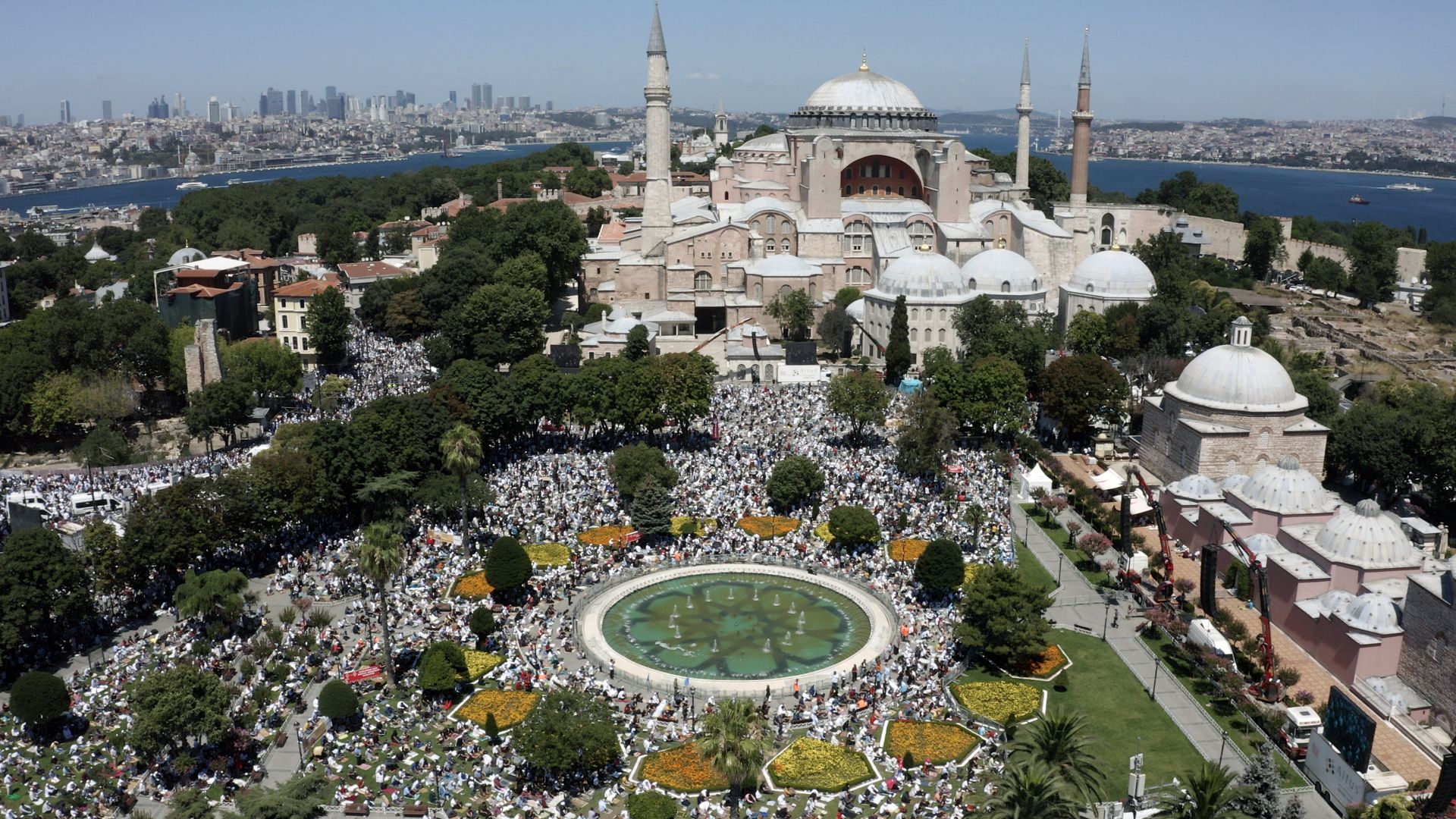 Hagia Sophia: Friday Prayer Sermon


