
IslamiCity
Listen PodCasts, Live Quran, Watch Videos @VideoHub

At first glance, you might wonder what a comprehensive, deeply spiritual way of life like Islam has to do with a game played on manicured greens, often associated with business deals and weekend leisure. One is a divine guidance for the soul, and the other is a sport where you spend hours trying to put a very small ball into a very small hole. But if you look a little closer, beneath the surface of the fairway, a beautiful and surprising common ground begins to emerge.
Here are some of the shared lessons.
I have played basketball, tennis, baseball, soccer/football, but there is something about golf that is profoundly different. It is not simply about hitting a ball; it is a profound game of intention, discipline, patience, and self-control. It asks you to manage not just the club in your hands, but the mind, the emotions, and the ego. And right there, on the tee box, is where, for me, golf begins to beautifully intersect with Islam.
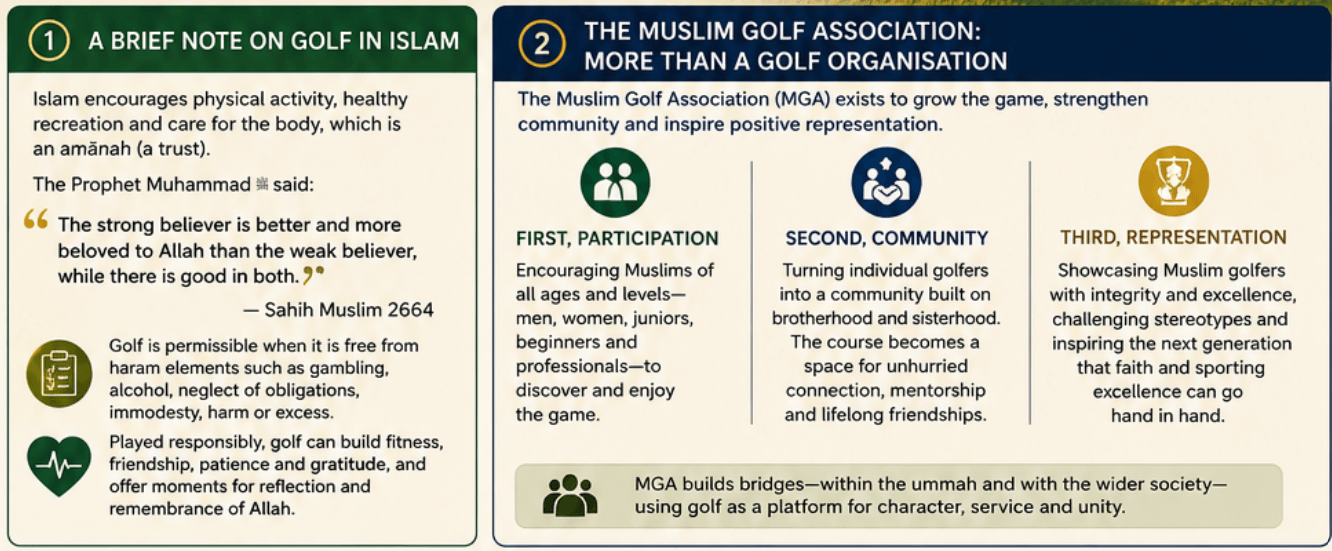
Let us start with the basics, because Islam actually encourages physical activity, healthy recreation, and the care of our bodies. The Prophet Muhammad, peace and blessings be upon him, gently reminded us that a strong believer is better and more beloved to Allah than a weak believer, though there is good in both. Our bodies are an amanah, a sacred trust, and keeping them healthy is a form of worship.
Golf, like any sport, is generally permissible and can be a wonderful source of exercise, fresh air, and companionship. The key, as with everything in our faith, lies in the moderation of boundaries. We simply have to ensure that our time on the course doesn't lead us into gambling, expose us to environments that compromise our values, or cause us to neglect our salah and family obligations. Islam does not ask us to withdraw from the world; it asks us to live in it with purpose, balance, and a constant consciousness of Allah. I have found the quietness of golf and the course can actually become a sanctuary for reflection and gratitude, especially on days with few players (usually due to bad weather).
| Aspect | The Islamic Approach to Golf |
| Encouraged | Physical health, fresh air, companionship, treating the body as an amanah (trust). |
| Boundaries | Avoiding gambling, ensuring time doesn't neglect salah (prayer) or family duties. |
| Core Principle | Living in the world with purpose and balance, not withdrawing from it. |
Now, I want to turn to something practical that weighs on the minds of many Muslims considering the game: what about prayer? A typical round of golf can stretch to four or five hours, often spanning the times for Dhuhr, Asr, and sometimes even Maghrib. The answer is simple, though it requires a bit of planning and execution. You stop, and you pray. Yes, even if you are playing in a Western country, even if your playing partners are non-Muslims who have never seen someone pray on a golf course. Find a quiet spot near the clubhouse, use a clean patch of grass away from the fairway, or even pray in the golf cart if necessary, my preferred route.
I'd like to believe that most reasonable people, Muslim or otherwise, respect someone who is committed to their faith. In fact, it often opens a door for conversation, for explaining your practice with grace and confidence. This has happened more than a few times during my time on the 9 and 18 holes.
The five daily prayers are not negotiable; they are the anchor of our day. A golf game can be paused, rescheduled, or shortened. The prayer time cannot. This is where our commitment to Allah takes clear precedence over our commitment to the game, and living that truth openly, without apology but also without aggression, is itself a form of dawah. It shows that our faith is not a private hobby, but a living, breathing reality that shapes our choices, even on a sunny afternoon on the golf course.
| Prayer Scenario | Practical Solution | The Principle |
| Dhuhr/Asr during round | Pause at the turn (between holes 9 and 10), find a quiet space near the clubhouse or in a secluded corner of the course. | Prayer times are fixed; the game is flexible. |
| Playing with non-Muslims | Inform them beforehand: "I'll need about 10 minutes to pray." Most will respect this. Use it as an opportunity for gentle dawah. | Confidence in faith invites respect; secrecy invites confusion. |
| Maghrib at sunset | If the round runs late, pray on the course if safe, or complete the round quickly and pray immediately after. | Do not delay prayer beyond its time for the sake of finishing a game. |
| Wudu (Ablution) | Use the restroom facilities at the clubhouse or halfway house. In a pinch, perform tayammum if water is genuinely unavailable. | Purity is essential, but Allah does not burden us beyond what we can bear. |
The Muslim Golf Association: More Than a Golf Organisation
I recently learned about a Muslim association dedicated to golf. It's called MGA, Muslim Golf Association, and they are not just trying to get more Muslims to swing a club like Tiger or Rory or my favorite golfer Fred Couples - Wikipedia; they are building bridges of belonging. They are creating spaces where a child can see their community on the course, where unhurried human interaction can flourish over a four-hour walk, and where Muslims can be authentically themselves while fully engaging in mainstream sporting culture. When Muslim golfers participate visibly and confidently, they gently challenge assumptions and show the world that faith is not an obstacle to excellence, but rather a foundation for it.
It becomes an intergenerational space where mentors guide beginners, and where the course itself becomes a classroom for character.
[This sense of belonging and purpose is exactly what makes the work of the Muslim Golf Association so deeply meaningful. For a long time, golf has been perceived as an exclusive world, and for a Muslim stepping onto the course for the first time, there is often a quiet, lingering question: Do I belong here? The answer, absolutely, is yes. Playing at world famous Torrey Pines Golf Course with my son few years ago was validation.

When you really think about it, the parallels between the game and our faith are striking, especially when we look at the concept of niyyah, or intention. The Prophet, peace and blessings be upon him, taught us that actions are but by intentions. Before you even take your first warm-up swing, you can ask yourself why you are there. Is it for exercise, for fellowship, or to clear your mind? By anchoring your intention in something pure, a simple round of golf transforms into an opportunity to practice patience, honesty, and good character. For me, the purpose changes the meaning of the activity.
Then comes the physical act of playing, which quickly becomes a masterclass in mastering the nafs, the self. Golf is a remarkably unforgiving game. You can hit the most beautiful drive of your life, furthest I ever hit was 310 yards down the middle of the fairway, only to turn a fade (or draw) into a slice (or snap-hook) as your second shot, often my achilles heel, into the water or parallel fairway (requiring a very loud 'FOUR!). The temptation is to react, to throw the club, to blame the wind, the trees, geese, (yes) alligators (having played in Florida) or your playing partner.
But the better golfer learns to pause, breathe, and reset. This is taking time and patience, and, inshallah, I will get there! This is the very essence of Islamic self-restraint. Every few minutes, the course asks you if you can control your anger after a bad shot, or if you can control your ego after a great one. The real opponent is rarely the person in the other cart; it is your own self.
This need for self-control ties beautifully into the focus and presence we strive for in our faith, much like the khushu we seek in our salah. Unlike a beginner, a good golfer develops a quiet pre-shot routine. They stand behind the ball, visualize the trajectory, take a deep breath, and commit to the swing. The goal is to eliminate mental noise and be entirely present in the moment.
If you are dwelling on the terrible shot you hit on the last hole, you will ruin the shot you are about to take now. It is a gentle reminder that constantly replaying the past or worrying about the future prevents us from properly inhabiting the present. We assess, we prepare, we commit, and then we accept the result. Put differently, man proposes, and God disposes!
| The Pre-Shot Routine | The Spiritual Parallel (Khushu) |
| Assess the lie & wind | Grounding oneself in the present reality. |
| Visualize the shot | Setting a clear, focused intention. |
| Deep breath & commit | Eliminating mental noise and trusting the process. |
| Accept the result | Practicing tawakkul (reliance on Allah) after the effort is made. |
That acceptance requires immense sabr, or patience. A round of eighteen holes is a game of recovery. I will guarantee that you will hit bad shots, you will miss easy putts (a four/five footer, seemingly without any breaks, that breaks one inch left before the cup), and you will face unexpected disasters, like slow four-some play (walkers) ahead of you that ruins your rhythm, requiring you to revisit the patience reference.
But you cannot go back and replay the previous hole; you can only play the next one. Islam places sabr at the very center of the believer's character, teaching us that patience is not passive resignation, but the ability to remain steady while continuing to do what is right. The golfer who learns to say, "That happened, now what?" becomes mentally unbreakable, and the believer who applies this to life becomes spiritually resilient.
Perhaps the most profound intersection, however, is found in the game's tradition of honesty and self-accountability, or muhasabah. Golf is unique because the player is often the only one who knows if a ball moved slightly, or if a drop was taken incorrectly. You are expected to call a penalty on yourself. To some, the temptation to stay silent when no one is watching is human, but integrity begins precisely in those quiet moments. The Quran reminds us to fear Allah and let every soul look to what it has put forth for tomorrow. Golf provides a practical, everyday exercise in this moral principle, teaching us that true character is what you do when nobody else is keeping score.
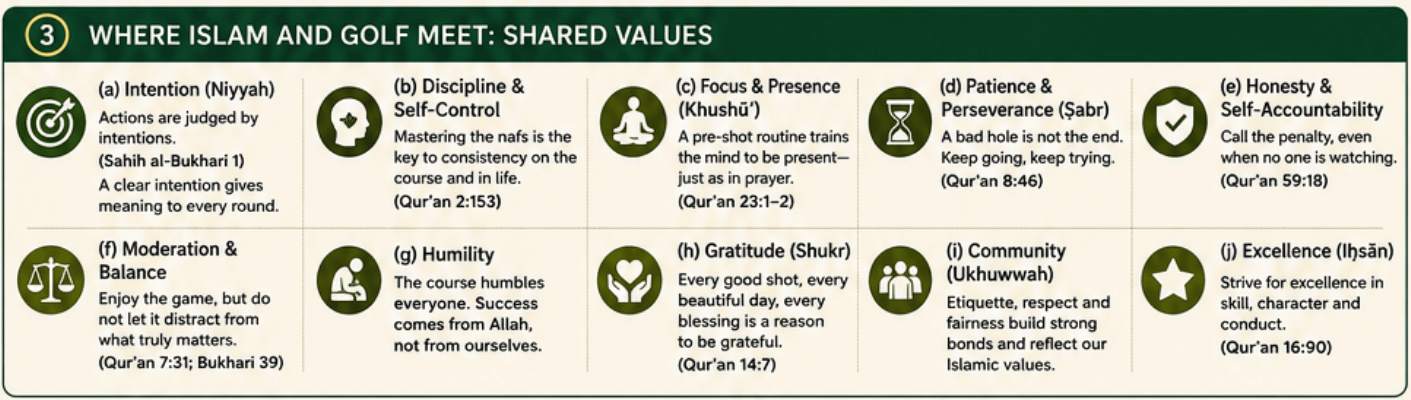
Through all of this, the game constantly teaches us moderation, humility, and gratitude. The course is blind, it has no interest in your wealth, your job title, or your education; a world class surgeon or tech-bro from silicon valley can shank with an eighth iron just as easily as a beginner, reminding us that competence in one area of life does not guarantee mastery in another. It keeps us humble.
And yet, it also opens our hearts to shukr, or gratitude. There is a natural gratitude in feeling the morning sun, hearing the birds, walking with a friend, and simply having the health and mobility to play the game. It reminds us to be thankful not just for the perfect shot, but for the very opportunity to be on the course.
What Can Muslims Learn from Golf and What Can Golfers Learn from Islam?
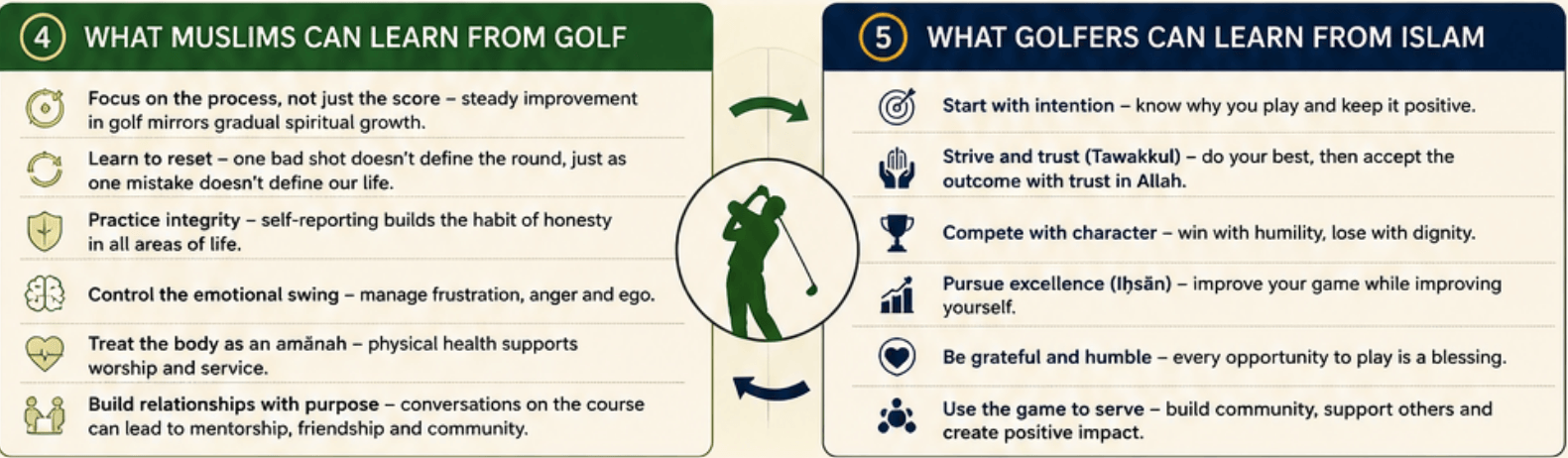
The beauty of this relationship is that it is a two-way street. We can learn to focus on the process rather than obsessing over the final score, to reset emotionally after a setback or two, and to treat their bodies with the care they deserve. At the same time, golfers can learn from Islam how to separate their effort from the outcome, placing their ultimate trust in Allah, which is the very essence of tawakkul. Islam teaches us to compete fiercely but without losing our dignity, to pursue excellence, or ihsan, without falling into arrogance, and to use the networks we build on the course to serve our communities. Put differently, we can be hyper-competitive, yet understand that character shines during adversity.
For those that have played golf over time, ultimately strange, maddening, and a beautiful game. You can spend thousands of dollars on the latest high tech equipment and still blame a tree for your bad shot. But somewhere along the fairway, it teaches you the most important lesson of all: you are not entirely in control.
You can control your preparation, your attitude, your integrity, and your response, but you cannot control every bounce of the ball or every gust of wind. For a Muslim, this is a profound reminder of our place in the universe. We strive, we prepare, and we do our absolute best, but the outcome belongs to Allah.
Betterment!
So, rather than just asking how we can get more Muslims to play golf, we should be asking how the game can help us become better Muslims, better neighbors, and better human beings. And conversely, how can our Islamic values help produce not just better scores, but better sportsmanship, deeper humility, and a stronger sense of community?
The answers lie somewhere between the clubhouse and the first tee. Because sometimes, the most important lesson of a round of golf has very little to do with the scorecard, and everything to do with who we become while playing the game.

Caveat: While this reflection explores the beautiful ethical and spiritual parallels between our faith and the game of golf, it is meant to inspire the heart rather than provide a specific fiqh ruling. For questions regarding particular circumstances or local contexts, it is always best to consult with a qualified scholar who understands your specific situation.
Rushdi Siddiqui is Co-Founder and CEO of FinanceILM.ai, an AI-powered Islamic finance Large Language Model (LLM) platform, and Co-Founder of the Capital Formation Institute in Islamic Markets, a think tank advancing governance and maqasid al-Shariah in Islamic capital markets. His work spans next-generation Islamic equity and sukuk indexes, as well as Shariah-based health and stress-testing frameworks for Islamic banks.
Rushdi serves as Head of Strategy & Innovation at IslamiCity.org, where he helps shape and advance the organization's broader AI strategy, including the development of ChatILM.ai and other AI-powered initiatives.He is also Co-Founder and Chairman of World Waqf Day, an initiative dedicated to highlighting the enduring social impact of philanthropy through the Islamic institution of waqf.
 UFC 304: Belal Muhammad Post-Fight Press Conference


