
IslamiCity
Listen PodCasts, Live Quran, Watch Videos @VideoHub

Every parent wants their child to succeed. We want our children to receive a strong education, develop confidence, learn valuable skills and have opportunities for a successful future. But for Muslim parents, there is another question that sits alongside academic achievement: What kind of person will my child become?
Education is not only about what a child knows. It also shapes how they think, what they value and how they understand their place in the world. A child may learn mathematics, science, technology and literature, but who is helping them understand their faith, develop good character, connect with the Qur'an and feel confident in their Muslim identity?
For many families, this has become increasingly difficult to balance. School, homework, extracurricular activities, sports, social media and other responsibilities can leave very little time for Islamic learning. Qur'an and Islamic Studies may become something fitted into the weekend or an hour during the evening. Gradually, Islamic education can begin to feel like something separate from a child's main education rather than an essential part of it.
This is not because parents do not care. In fact, it is often because they care deeply. They want their children to receive the best academic opportunities while also remaining connected to Islam. The challenge is finding an educational environment where these two priorities do not constantly compete for a child's limited time and attention.
The question becomes even more important as children grow older. A young child may happily attend Qur'an class, but teenagers face a much wider world of questions and influences. They are navigating friendships, social media, identity, relationships, peer pressure, career ambitions and ideas about what success really means. They need more than information about Islam. They need an understanding of how their faith can guide them through the decisions and challenges of everyday life.
The Qur'an places great importance on knowledge. Allah asks, "Are those who know equal to those who do not know?" (Qur'an 39:9). But Islamic education has never been simply about memorizing information. Knowledge is meant to lead to understanding, reflection, responsibility and good character. A complete education should therefore help a young person develop both intellectually and morally.
This matters even more today because education does not happen only inside a classroom. Children are learning constantly through YouTube, social media, games, influencers and online communities. They have access to more information than any generation before them, but information does not automatically provide wisdom. Young people also need the ability to question what they see, understand different ideas and make decisions based on a strong moral foundation.
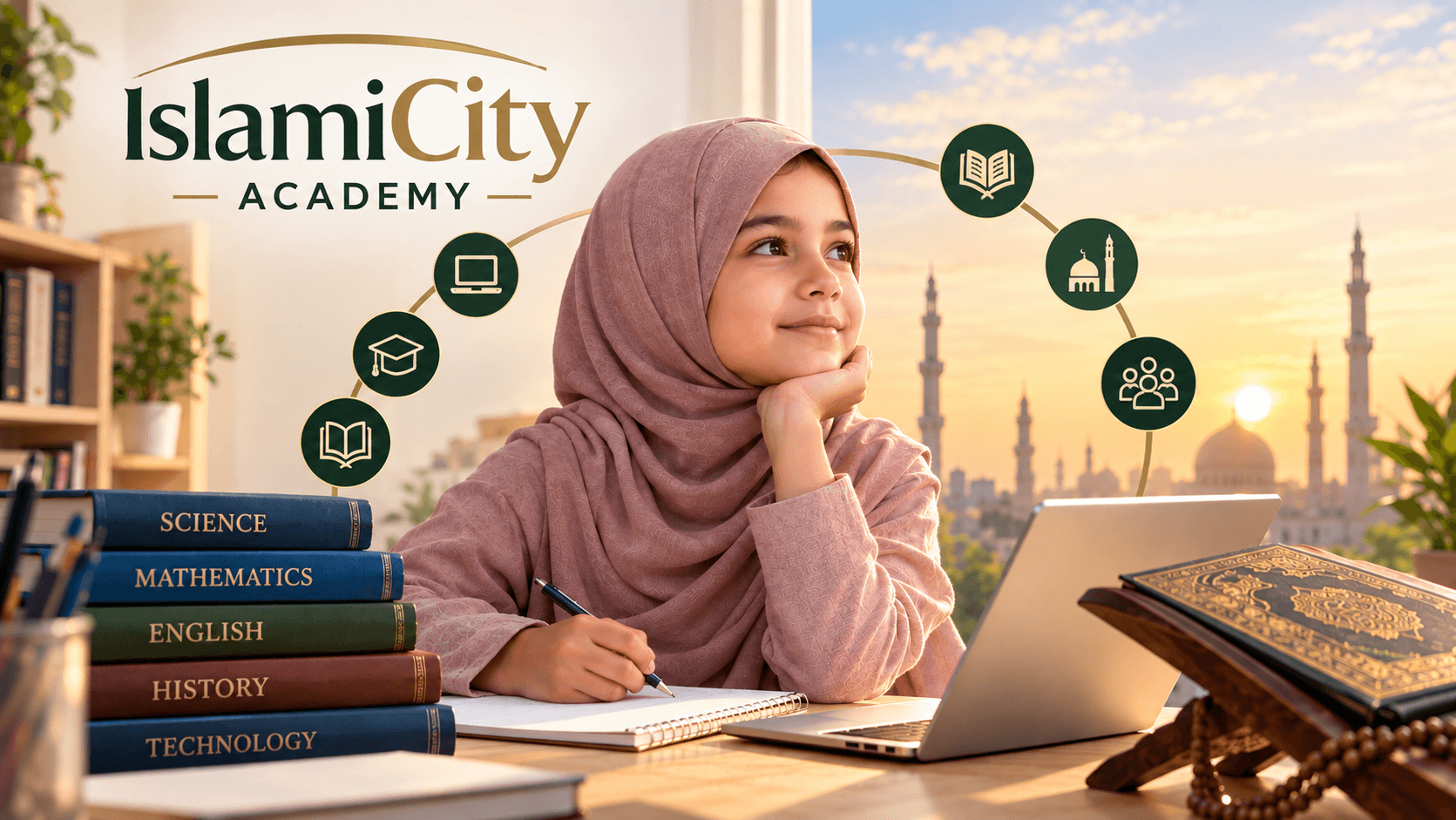
This is one reason an educational model that brings academic and Islamic learning together is worth considering. Rather than treating Qur'an, Arabic and Islamic Studies as subjects that must compete with a child's academic education, they can become part of the same educational journey.
IslamiCity Academy offers this kind of approach through flexible online education for students from Kindergarten through Grade 12. Alongside core academic subjects, students have opportunities to study Arabic, Qur'an and Islamic Studies. The aim is not to replace academic preparation with religious education, but to bring the two together.
The academic side of the program is also designed with students' futures in mind. Students can study core subjects such as mathematics, English, science and history, while high-school students can progress into areas including chemistry, physics, economics, government and computer science, with advanced options such as AP Calculus and AP English. This means that Islamic education does not have to come at the expense of academic ambition.
The online format also offers something that many modern families increasingly value: flexibility. Every family has different circumstances, and not every child learns in exactly the same way. Online education can provide families with greater control over when and where learning takes place while still giving students access to a structured academic program.
For Muslim families, however, perhaps the most meaningful question is not simply what subjects a child studies. It is what relationship that child develops with knowledge, faith and identity.
There is a difference between a child who simply knows a few Islamic facts and a young person who understands that Islam has something meaningful to say about knowledge, ethics, relationships, responsibility, justice and the purpose of life. A child should be able to pursue excellence in science or mathematics without feeling that their faith belongs in a separate part of their life.
The Qur'an itself gives us a powerful reminder of this balance: "Seek, through what Allah has given you, the home of the Hereafter, and do not forget your share of the world." (Qur'an 28:77). Islam does not ask us to turn away from worldly knowledge or achievement. Rather, it teaches us to pursue them with purpose and within a larger understanding of our responsibilities to Allah and to one another.
That is perhaps the conversation Muslim parents need to have about education today. It is not simply about choosing between a strong academic education and a strong Islamic education. The better question may be whether our children can receive both in a way that allows each to strengthen the other.
Of course, there is no single educational model that will be right for every family. But for parents looking for an environment where academic learning and Islamic identity can develop together, IslamiCity Academy offers one possible path. With K-12 education, core academic subjects, Qur'an, Arabic and Islamic Studies, it provides an opportunity to make faith part of the educational journey rather than something that has to be added around it.
Because ultimately, education should prepare children for more than exams, college or a career. It should help prepare them for life. And for Muslim parents, that means hoping our children grow up knowledgeable and capable, but also grounded, principled and confident in who they are.
The goal is not simply to educate the mind. It is to help raise a generation that knows how to use that knowledge-with faith, purpose and character.
 UNICEF: Gaza has Become Graveyard of Children


