
IslamiCity
Listen PodCasts, Live Quran, Watch Videos @VideoHub

The truth of Islam - revealed to all prophets, with Prophet Muhammad ﷺ as the Seal of the Prophets - is so self-evident and so nourishing for humanity's essential needs that nothing can be instituted as a viable alternative to it. This was the case before the sending of the final Prophet, it remained the case after his sending, and it continues to prove itself today.
Myriads of quasi-religions, ideologies, philosophies, and intellectual fashions keep mushrooming on a regular basis. Yet, as soon as they emerge and begin pretending to establish themselves, they start waning and eventually disappear. Their problem is intrinsic: when placed side by side, truth and its antithesis, falsehood, stand on entirely different grounds. Falsehood may become fashionable, powerful, or widespread for a time, but it possesses no enduring foundation capable of withstanding the truth.
This is known to all adversaries of the truth and its people, including their chief, Satan. They know that standing up directly against the truth is an impossible task. Consequently, the only - and at the same time most "potent" - thing they can do is to invent distractions and diversions. If the truth cannot be defeated, it can at least be obscured; if it cannot be silenced, it can at least be drowned out by noise. The objective is not necessarily to make people reject the truth openly, but to prevent them from hearing it clearly, reflecting upon it deeply, and living by it consistently.
Distraction is thus a strategy of displacement. It takes attention away from what is essential and directs it towards what is secondary, temporary, superficial, or inconsequential. The believer may continue to profess the truth while gradually becoming too occupied to embody it. His faith remains in principle, yet his attention is consumed by an endless succession of things that demand his time, emotions, curiosity, and energy. In this way, the truth is not defeated; it is simply crowded out of consciousness and conduct. Yes, exactly that is all they can do, and that is all they keep doing. Frustration and desperation perhaps best capture the nature of their actions.
Satanic Distraction: From Paradise to Lahw and La'ib
From the dawn of the confrontation between truth and falsehood, and between light and darkness, in Paradise, when Satan entered into confrontation with Adam and his wife, the nature of this struggle was already foregrounded. Satan proved incapacitated, though willing; ineffective, though ostensibly resourceful. The most he could do was talk, make false promises, and lie in order to disturb Adam and Eve, upset their concentration, and temporarily disrupt their priorities.
The episode revolved around Satan's promise that he wanted to guide Adam and Eve to the tree of eternity and everlasting authority, which he falsely presented as something destined never to fade away, while swearing that he was their sincere adviser. Here resides the essence of satanic distraction: the substitution of illusion for reality, immediate attraction for lasting consequence, and imagined gain for genuine felicity. Satan cannot create truth, but he can distort perception. He cannot provide genuine nourishment to the human soul, but he can persuade the soul to seek nourishment in substitutes.
It is owing to this that, in Islam, the ideas of entertainment and leisure assume a different meaning. Human beings require rest, recreation, enjoyment, and moments of relief, but these must remain subordinate to the purpose for which man has been created. Life is too short and too precious to be surrendered to nonsense and non-productive pursuits. Even leisure can be elevated, regulated, and spiritualized when it serves legitimate human needs and remains within the boundaries of morality. Under no circumstances should it become a pathway towards immorality, heedlessness, or the abandonment of responsibility.
The danger becomes particularly acute when truth is distorted or abandoned. A serious vacuum is then created within the human heart, soul, and mind, and that vacuum must be filled. Human beings cannot live indefinitely without meaning, purpose, orientation, and something towards which their deepest longings are directed. When the truth is removed, proxies inevitably rush in. However, because these stand-ins cannot satisfy the fundamental needs for which the human being was created, they generate an endless demand for further stimulation. One distraction requires another, one pleasure must be followed by another, and one diversion must constantly be replaced by something louder, newer, or more absorbing.
It is then and there that all doors are left ajar for Satan to step in and dictate the terms of engagement. He becomes, metaphorically, in charge of both the protocols and the results. The Qur'an portrays this condition through concepts such as lahw and la'ib: divertive amusement and play. The problem is not that every form of recreation is inherently forbidden or meaningless. The deeper problem is allowing amusement and play to become the governing principle of existence. If truth presides over decision-making and behavioral patterns, lahw and la'ib can remain controlled and properly proportioned. If the voice of truth is silenced, nonetheless, the environment of lahw and la'ib grows empowered until it begins to govern the individual rather than serve him.
The Tyranny of Ghaflah
What then ultimately overpowers and enslaves the human being is heedlessness (ghaflah) - a state of mind and being in which consciousness of what truly matters becomes eclipsed and the forces of distraction are allowed to assume command. One may wrongly presuppose that ghaflah is a dormant, passive, or virtually inactive state. Nay, it can be among the most devastating conditions to afflict the human being, precisely because it works slowly, subtly, and often imperceptibly, gradually tearing apart the fabric of one's inner being.
It is a condition at whose door the Qur'an places responsibility for much of human wrongdoing and loss. Its destructive power lies in the fact that it does not necessarily require a person to reject the truth openly. A person may know the truth, acknowledge it, and even profess allegiance to it, while allowing heedlessness to prevent that truth from regulating his actual existence.
Thus, one may be fully aware of one's duties towards Almighty Allah yet regularly, or even completely, compromise them. One may know the prohibitions established by the Creator and still rarely, or never, hesitate to transgress them. Knowledge remains present, but consciousness is absent; recognition survives, but attentiveness has been weakened. The person does not necessarily cease knowing what is right and wrong. He simply becomes progressively less responsive to that knowledge. This is the subtle tyranny of ghaflah: it separates awareness from action, knowledge from obedience, and truth from lived reality - something from which many Muslims nowadays, unfortunately, suffer greatly, even while proudly claiming their Muslim identity.
In this sense, heedlessness is more dangerous than a momentary distraction. Distraction may occupy the attention temporarily; ghaflah gradually reshapes the condition of the person who repeatedly surrenders his attention to it. What begins as amusement can become habit, what becomes habit can develop into attachment, and what is repeatedly attached to can eventually become a governing force. The human being then ceases to ask whether what occupies him is worthy of his time, thought, and existence. He naively follows whatever calls most loudly for his attention. His life becomes an interplay and clash of algorithms, each competing for his consideration, shaping his choices, and directing his desires. His life becomes reactive rather than purposeful, fragmented rather than integrated, and ensnared rather than liberated.
The Institutionalization of Distraction
The same principle operates at the institutional and civilizational levels. Life systems and (un)civilizational trajectories of nations and communities normally adopt diversionary models in order to justify their raison d'être and maintain control over the masses, particularly when people begin realizing what is happening and start demanding improvement. Distraction can then become systematic. It can be built into institutions, commercialized through industries, amplified through mass communication, and normalized until people cease recognizing it as distraction at all.
It was the proponents of certain modern ideological systems who popularized the slogan that religion is the "opium of the masses." Through such thinking, heavenly influence over terrestrial life was to be neutralized or diminished. Once the reach of transcendent authority was excluded from the human realm, however, another form of authority was bound to take its place: the authority of systems, institutions, ideologies, markets, and those who control them. On this account, one form of "opium of the masses" was merely replaced with another. The vocabulary changed, but the function of diversion remains.
They all know all too well that there is little of substance or nourishment that they can offer. Dishonesty and fabrication thus become the only means left to them to remain afloat. Consider, for example, the West-dominated modern civilization, which is proving to be a failed civilizational experiment - or, at best, the anticlimactic conclusion to what appeared, and was so confidently paraded, as a promising new chapter in human history during the periods of the Renaissance, the Enlightenment, and the Industrial Revolution. What was heralded as the dawn of unprecedented human progress has, in many respects, given way to disappointment, frustration, and outright failure. As the reality increasingly diverges from the promise, the greatest achievement of modern civilization may well be its popular culture: its remarkable ability to translate life into a vast universe of distraction and diversion, deflecting people's attention from what the situation actually is towards what it is not, or what they wish it to be.
It should therefore come as no surprise that innumerable forms of pleasure-seeking and self-indulgence have become some of the most conspicuous features of modern civilization. There are, certainly, many sectors of modern life that are either neutral or highly commendable in themselves. Yet even these, when pushed to their ultimate ends, are often subjected, in one way or another, to the generation, articulation, refinement, and optimization of the very hedonistic pursuits mentioned above. Indeed, ours is a civilization of fleeting delights and a culture of squandered hours. Our society is drunk on amusement, and our world enthralled by diversion.
Towards this end has emerged an enormous repertoire of entertainment, music, sport, spectacle, consumption, commercialized sexuality, and perpetual amusement - precisely in an age when man lives ever further from himself, from nature, and, ultimately, from his Creator. So much emptiness has been generated within and around man that carefully devised and sustained schemes of diversion keep him perpetually occupied, leaving scarcely any room for reflection, stillness, or self-recovery. He is encouraged to believe that everything is fine when very little is, and that the civilization appears in harmony, though only a fraction sings the right note. He is kept emotionally stimulated yet intellectually distracted, constantly occupied yet spiritually unfulfilled.
Man must thus be intoxicated with false attractions and malnourishing surrogates until he becomes unable to discern reality from fantasy, righteousness from depravity, and, perhaps most critically, his real self from his fictional counterpart. The tragedy is not simply that he is distracted. It is that he may eventually come to identify distraction with life itself.
If the Romans had their bread and circuses, the Egyptians their magic, the Greeks their Olympic Games, and the Mesopotamians their festivals and spectacles, then today's so-called modern civilization has its pop culture (the theatre of the masses), which is vast in scale, sophisticated in technique, breathtaking in appearance, yet shallow in substance and empty of meaning. All is but a veneer; remove the glittering facade, and the abyss yawns beneath.
Staying the Course: The Believer's Refuge
No wonder, then, that in such an alarming ecosystem, the people who remain attached to Islamic truth constitute a profound obstacle to the culture of distraction. They can still see the larger picture, recognize the true nature of affairs, and conduct themselves accordingly. No wonder, furthermore, that they become targets of both Satan and his armies from among the jinn and humankind. Islam cannot be annulled and substituted with something else - not even remotely. The more practical objective, therefore, is to flood the believer's mind, life, and surroundings with noise and distraction until his truth-oriented focus is weakened and every dimension of his honorable life becomes occupied by secondary concerns.
The result is the incessant and pervasive presence of local and international, basic and elaborate, lahw and la'ib wherever one goes and, all the time more, wherever one looks. It is an invasion of attention from which there seems to be no escape. The believer's response, however, need not be complicated. He needs to remain steadfast in what and who he is: a believer. He must protect his attention as carefully as he protects his faith, resist the temptation to confuse activity with productivity, and refuse to allow noise to determine the rhythm of his existence.
Simply put, he needs only to remain himself and stay the course. As the Qur'an says of the servants of the Most Merciful, "when the ignorant address them, they say, 'Peace'" (25:63), and "when they pass by laghw (ill speech), they pass by it with dignity" (25:72).
His real refuge lies at levels inaccessible to the advocates and activists of noise, clatter, and aggressive (mis)behavior: the levels of spiritual excellence, moral commitment, intellectual seriousness, and purposeful living, all rooted in faith, certainty, and servitude to the Creator and Sustainer of the universe. The believer does not defeat distraction by becoming louder than it. He defeats it by refusing to become distracted. He turns his attention back to what is essential, orders his life around truth, and remains conscious of the rationale for which he was created.
For Satan's greatest weapon is not the ability to destroy the truth. It is the ability to make human beings too distracted to hear it, too occupied and confused to contemplate it, and too absorbed in fake alternatives to live by it. That is why, when a person dies and the effects of distraction come to an end - that is, when the noise finally falls silent - he realizes what was actually going on and understands that he had been duped. No sooner does this realization dawn upon him than he wishes to return to life and live differently. But, as the Qur'an repeatedly verifies, it will be too little, too late. The only chance he was given has been squandered. He should have understood that life was about struggle and active participation in its currents, in lieu of sham high living and the chasing of shadows, ultimately returning to Allah bruised yet victorious, exhausted yet transformed, and tested yet genuinely enlightened.
Hence, the message to each and every Muslim is simple: make the timely performance of salah, the Qur'an, the remembrance of Allah, the emulation of the Prophet, beautiful akhlaq, etiquette, and affirmative mindset among your best and most constant companions. Let them remain close to you throughout the day and accompany you wherever you go. In this manner, your attention will remain anchored in reality, normalcy, appropriateness, and beauty, and your life will remain oriented towards what is true, wholesome, and worthy.
It is truly inconceivable that a person who claims to be Muslim seldom or never reads the Qur'an - not mechanically, but in order to understand what his Creator communicates to him, so that he may live accordingly. Nor does he read the biographies of his Prophet so that he may know more about the most exemplary personality from whom he is supposed to draw inspiration and whom he is supposed to follow. Nor does he generally read useful material about his din (religion) of Islam so that he may live a better, more meaningful, and more consequential life.
If, however, a person's physical body, mind, heart, and soul are not in harmony when it comes to both the quality and quantity of his servitude to Almighty Allah, one ought to examine how sincere and how committed a Muslim he truly is. This is all the more necessary lest his submission to distraction, rather than to his Creator, get the better of him in this world and, ultimately, in the Hereafter.
This is all, furthermore, lest such an unfortunate soul, at the moment of death, find itself crying out: "My Lord, send me back, that I might do righteousness in that which I left behind" (Qur'an 23:99-100). Without doubt, the only path to true happiness is to live life neither according to one's own whims nor according to the dictates of others, but solely according to the will of the Creator of life.
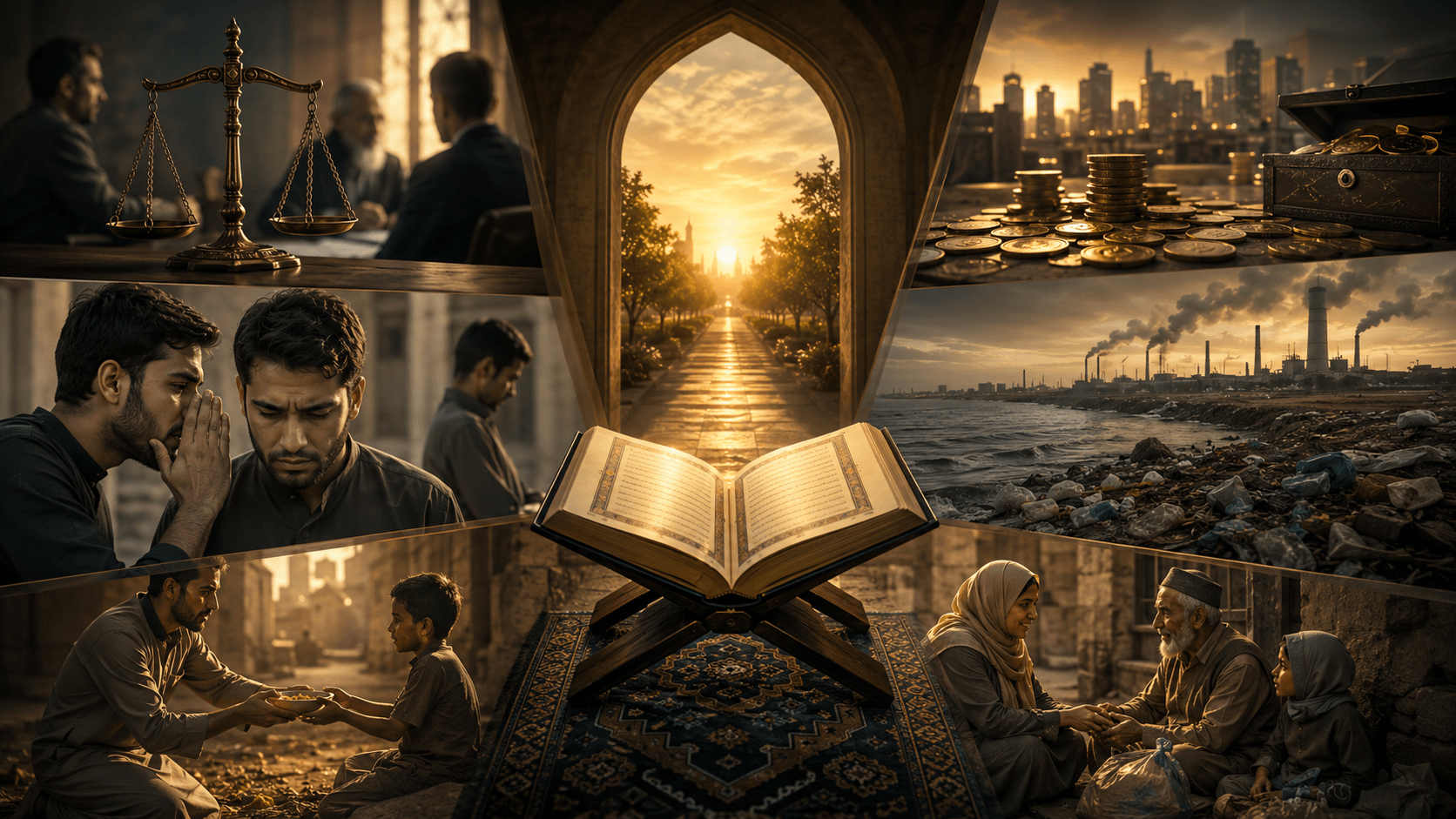 The Quran Warned Us About These 5 Things — And We Still Do Them


