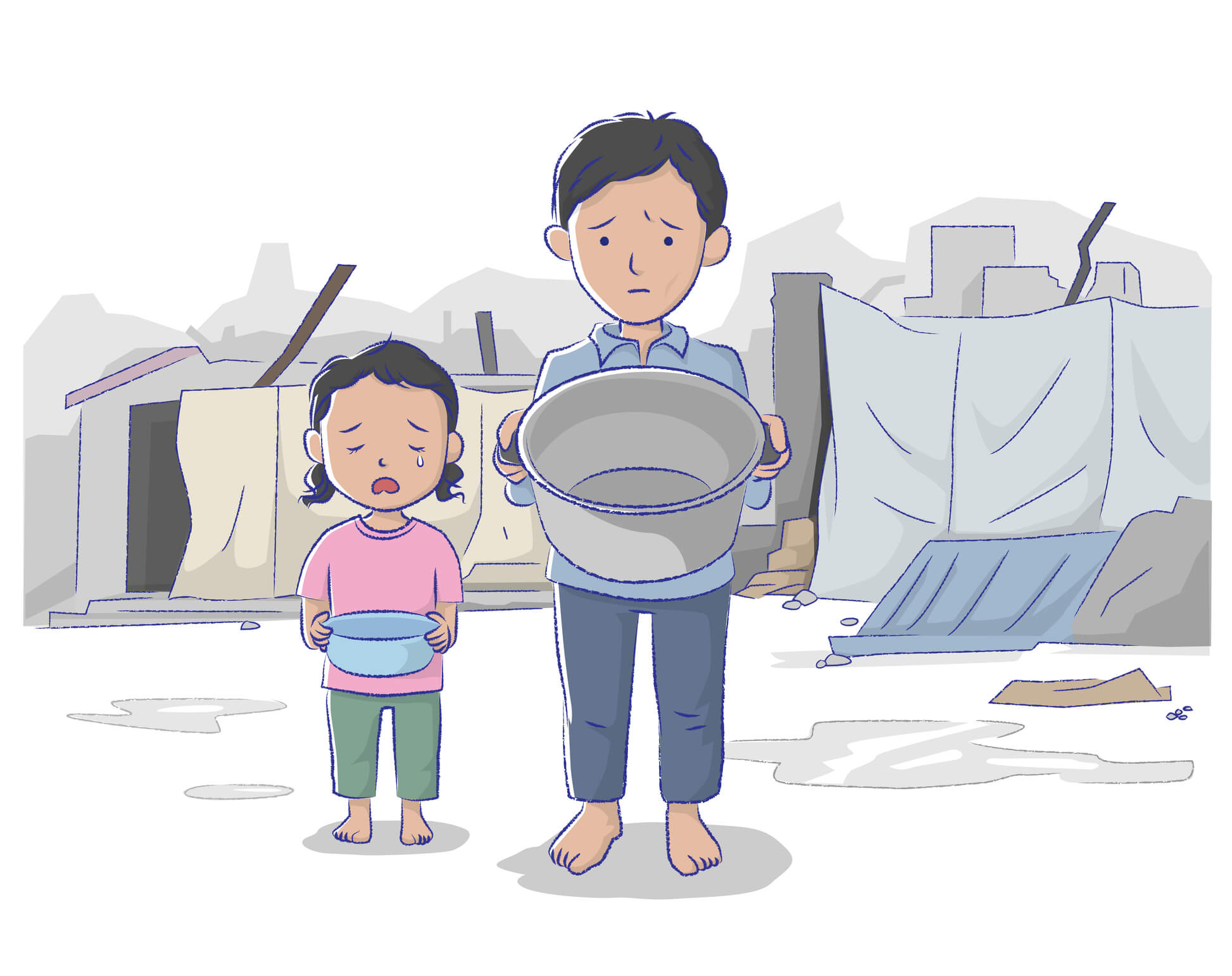
Hunger is widespread in the world. According to World Hunger statistics, 785 million people across the globe do not have enough food to sustain a healthy lifestyle, equaling one in nine people.
Surprisingly, the majority of hungry people live in developing countries. Poor nutrition causes 45% of deaths in children under the age of 5, meaning just over 3 million children a year die because they don't have access to enough access to enough nutritious food.
World hunger is a complex issue. Among World hunger solutions offered are the following: 1. Help people provide food for themselves in a sustainable way; 2. Give people in developing countries access to credit so they can create their own farms; 3. Encourage individuals and businesses to donate to hunger relief organizations; 4. Provide access to education, which is the best defense against poverty and hunger; 5. Allow for increased government intervention.
Some experts believe the answer to world hunger is much more straightforward. They believe the key to ending world hunger cis to stop wasting food. The most wasted foods include vegetables, cereals, and starchy roots. These foods are wasted during agricultural production and in postharvest storage. Foof waste increases the need to produce more food. When not enough food gets produced, people go hungry.
World Food Day
Ending hunger is within reach. The world already produces enough food to nourish everyone. Yet as conflict, economic instability, and climate shocks put pressure on agriculture and food systems, the challenge is how to ensure access to reliable, affordable and nutritious food for people everywhere. World food Day is held every year on October 16. The Food and Agriculture Organization of the United Nations (FAO) established World Food Day at their 20th General Conference in 1979. October 16 commemorates the anniversary of FAO founding. More than 150 countries unite to raise awareness of the issues surrounding poverty and hunger. Since 1981, The FAO has selected a specific theme for the World Food Day.
The theme for 2026 is "Innovate today, nourish tomorrow" Innovation is transforming how food is produced, stored, transported and marketed. It brings together advances in science and technology with the knowledge, experience and ingenuity of farmers, fishers, herders and foresters - including women, youth and indigenous people as well as investors, policymakers, and entrepreneurs, because transforming our agriculture-food systems requires collective action.
Innovation in agrifood systems takes many forms. It includes digital advisory services, data and information systems, improved seed varieties and biotechnologies, along with farmer field schools, cooperative models, traditional land and water practices, and new approaches to production, markets, finance and distribution. Innovation can also mean reducing risk before crises emerge; preventive and cross-sectoral approaches can strengthen resilience and avoid far higher costs once shocks take place.
Together, our efforts to foster innovation can build agrifood systems that are more stable, more inclusive and more resilient - capable of nourishing people today while protecting the resources future generations depend on.
How to observe World food day
Over 150 countries observe World Food Day. In the United States, 450 national organizations sponsor the day. As part of their sponsorship, some organizations host Sunday dinners. Across Europe, ministries, universities, and research agencies organize conferences, exhibitions and broadcasts. The Pope sends a specific message for food producers and consumers. World Food Day events in Africa, Asia, and Latin America include agricultural fairs, debates and special ceremonies in schools and places of learning. You can't solve the world hunger problem. You can help do your part. On World Food Day, donate to your local hunger-relief organization. If you know of a family in need, anonymously send a gift. Spend awareness of the day.
Top ten causes of world hunger
One of every 11 people go hungry each day. The following are the top 10 causes of world hunger taken from Concern USA dated October 18, 2025, and what we are doing to solve them: Poverty and hunger go hand in hand. The last five years have been difficult, and after years of improvement, the numbers started to reverse course beginning in 2020, owing to fatal combination of COVID -19 pandemic, rising conflict, and consecutive climate emergence (especially droughts). These are three key causes, but they are not the whole story. Updated for 2025, these are the ten largest contributing factors to our global food security crisis.
- Poverty: Families experiencing poverty usually can't afford enough enough food for everyone to eat. If they can, it's often not food that provides the full range of vitamins and nutrients that people need every day to thrive. This undernourishment can lead to an intergenerational cycle of poverty. Children who don't get enough food have greater difficulties focusing in school, which can hinder their chances of getting a complete education and higher-paying job than their parents. Parents who skip meals to make their food stretch may also struggle with work, limiting their earning potential. It's a vicious cycle. We can see the link between poverty and hunger play out at the macro level as well: The Democratic Republic of the Congo is one of the world's poorest countries. Last year, nearly 75% of the country's residents lived below the poverty line.
- Food Shortages: Sometimes it's not even an issue of funds, but one of supplies. In low-income farming communities, families often experience periods before harvests known as hunger seasons. These are the times of year when food supplies from the previous harvest are used up, but the next harvest is still a ways off. This leaves families forced to skip one (or more) meals each day in the period before the next harvest, which could be months away.
- War and Conflict: Conflict and hunger form another vicious cycle, both for countries experiencing active conflict and even for those that aren't. For countries in conflict, violence can lead to the destruction of farmlands, displacement, and people sheltering at home for their own safety. Conflict also leads to high inflation rates that make food available at the market unaffordable for many civilians.
- Extreme climate and natural disasters: Natural disasters are also a major cause of hunger, with each event (big or small) setting the most vulnerable people and communities further and further back. As we've seen in recent years, climate shocks have also become more frequent and more destructive as a result of global warming. Extreme climate patterns also tend to have a higher effect on low-income areas of the world. The World Bank estimates that the climate crisis has the power to push more than 100 million people into poverty over the next decade, which in turn will have a direct impact on hunger rates.
- Poor nutrition: Families living in poverty often rely on just one or two staple foods, like corn or wheat, for the majority of their meals. As a result, they don't get enough critical macronutrients and vitamins. Even if they feel full, they may still be suffering the effects of hidden hunger. Nutrition is especially key for child development during the first 1,000 days between being in the womb and their second birthday. If a child suffers chronic malnutrition during this time, they may face a lifetime of health and developmental issues. Likewise nutrition is also important for maternal health. Mothers-to-be need even more vitamins and minerals in order to deliver a healthy newborn.
- Poor public policy and political instability: Systemic problems, like poor infrastructure or low investment in agriculture, often prevent food and water from reaching the populations that need them the most. This is especially true in fragile contexts, which is why many of the hungriest countries in the world are also experiencing some form of political instability. If resources are limited, leaders may focus them on the most pressing emergencies. Unfortunately, hunger is often a silent crisis in these cases. With decades of crisis in Somalia for example, the recent Horn of Africa drought carried an even larger impact on millions who faced hunger as a result. The issue wasn't just failed crops or drought-related displacement, but a much larger contextual problem.
- Economic downturn: Inflation as the result of a bad economy means that, even if food is available and people have jobs, they may not be able to afford even the most basic staples. Last year, for example, the cost of an emergency food basket rose by 66% in Ethiopia.
- Food waste: According to the World Food Program, over 1 billion tons of food produced is never consumed. That's equivalent to us throwing out one-third of the global food supply every year. What's more, producing this wasted food also uses other natural resources that, when threatened, have a ripple effect in the countries that are already hit hardest by hunger, poverty, and climate change. Producing this wasted food requires an amount of water equal to the annual flow of Russia's Volga River, and nearly 3 billion tons of greenhouse gasses to the atmosphere.
- Gender inequality: The UN notes that if female farmers had the same access to resources as their male counterparts, the number of hungry people in the world could be reduced by up to 150 million. Female farmers are responsible for growing, harvesting, preparing, and selling the majority of food in low-income countries. Women are on the frontlines of the fight against hunger, yet they are frequently underrepresented at the forums where important decisions on policy and resources are made.
- Forced migration: Hunger can be a cause of forced migration. Forced migration can also be a cause of hunger. Refugees and internally-displaced people living in displacement camps or informal communities are often legally or linguistically prevented from getting work to support their families while away from home (many refugees are also women and children, which means their options are even more limited). Many refugees live in neighboring countries, countries with limited resources to begin with. Some of the hungriest countries in the world are also among the largest host communities or have high rates of internal displacement. Emergency food assistance helps, but the problem of hunger and migration can only be resolved with a political solution.
Hunger in Africa.
While Global food crisis has improved in some parts of the world, the hunger crisis in Africa is deepening . Conflict, extreme weather, economic instability, and displacement are driving a rise in food insecurity, with women and children being disproportionately affected. Fast facts about Africa Hunger Crisis
According to world vision of January 16, 2026 following are the fact of Africa hunger crisis: - One in five people in Africa were chronically malnourished in 2024, meaning they lacked access to sufficient and nutritious food, a rate above the global average.
- Conflict, displacement, climate shocks, and rising food prices, were key drivers of crisis-level hunger.
- Hunger continued to rise in most sub-regions of Africa, even as global hunger rates inched down.
- Famine conditions have been officially confirmed in Northern Sudan, home to more than 40,000 displaced people.
- Across West and Central Africa, more than 36 million people struggled to meet basic food and nutrition needs as of early 2025, with projection of over 52 million faced hunger during the 2025 season.
Main causes of hunger in Africa
Regional and global conflicts extreme weather, and poverty have collectively driven instability and hunger in Africa. A food crisis transitions into famine when at least 20% household in a given area face extreme food shortages , more than 30% of children suffer from acute malnutrition, and hunger leads to more than 2 deaths each day for every 10,000 people. When a food crisis no longer meets these criteria, a famine is over at least temporarily, according to World Vision. Asia Hunger facts
Although Africa is frequently presented at the center of world hunger, Asia has always had more hungry people and more malnourished children because Asia has so many more people. - 64% of all malnourished children in the world live in Asia.
- 519.6 million adults and children in Asia consume too few calories, accounting for about 12% of the total population of Asia.
- More than half of all stunted children under five lived in Asua in 2017.
- In 2017, Asia accounted for more than two thirds of all wasted children under 5.
- Southern Asia had the highest Global Hunger Index score of 30.9 indicating serious levels of hungerin 2017.
However, There has been progress in Asia. There has been decrease of stunting, wasting and micronutrient deficiencies across board. On 17 December 2025 FAO regional office for Asia and the Pacific said Asias and Pacific made progress against hunger, but the nutrition challenges remain, in addressing malnutrition, food insecurity, and unequal access to healthy diets. in 2024 the prevalence of undernourishment declined to 6.4 percent down from 7.0 in 2023. This progress translated into 25 million people just in one year.
Despite this, the report cautions that progress is uneven. with nearly 80 percent of people in South Asia facing hunger. Overall, Asia and the Pacific region still account for nearly 40% of the world's hunger. underscoring the regions' critical role in achieving global security. and nutrition goals.
Hunger is only one dimension of the region's nutrition challenges. In 2024, almost a quarter, 24.4 percent of children under 5 were stunted, with South Asia recording the highest at 31.4 percent. Child wasting also remained alarming high at 8.9 percent.
The region has a double burden of malnutrition. And the cost of a healthy diet in the region averaged USD 4.77 per person per day in 2024, which is higher than global average. Although the proportion of people unable to afford a healthy diet has declined, affordability remains a major barrier. South Asia continues to face the greatest challenge with 41.7 percent of its population unable to afford nutritious food. . .
Hunger in America
Hunger touches us all and it holds back our families, and communities from reaching their full potential. The good news is together we can create a future where every person has the food they need to thrive. Discover how hunger affects your neighbors, and how your actions can make a difference. Everyone deserves healthy food t0 live a full, healthy life. Yet millions of hardworking families experience food insecurity. When people don't have access to required food , it can impact their health, education, and future opportunities.
About 48 million people in the United States experience food insecurity affecting their health and opportunities to thrive. And one in Five children, or 14 million children may not be able to access the food they need to grow up strong.
Food insecurity in experienced everywhere, no community is untouched. And over 50 million in the U.S. turn to food banks and pantries for help. It is not because there isn't enough food in America, hunger is caused by roadblocks that keep too many people from getting the nutritious food we all need to live well.
Lack of transit, safe places and can make it harder for some families to get food they need. Low income, loss of job, or disability can make it harder even for a working family to get food they need. Low pay, loss of a job, or high cost of living and health challenges may be other factors.
Which countries waste the most food and how to reduce waste
In an article published in Al Jazeera on October 16, 2026 Marium Ali and Mohamed Hussain wrote an article under the above heading. The article said for every five plates of food served in the world, roughly one ends in the bin adding up more than a billion tons of food a year. Meanwhile, 645 million people, about one in 13 of the world's population went hungry in 2025, according to UN estimates. That gap is the focus of World Food Day on October 16, the annual UN observation marking the founding of the Food and Agriculture (FAO) in 1945. This year's theme, "Innovate today, nourish tomorrow" calls for food systems that feed more people and waste less. Al Jazeera presented a visual presentation of global hunger and which countries waste the most food and simple ways to waste less at home.
Africa has more people hungry than any other region. In 2025 an estimated 309 million in Africa were undernourished, that is one in five people on the continent and almost half of the world's hungry people. By comparison, 292 million people in Asia, 6 percent of the population and 32 million in Latin America and the Caribbean, 4.8 percent, were undernourished .
The 2026 Global Hunger Index shows a similar pattern at the country level. The index scores countries out of 100, combining undernourishment with child stunting, child wasting and child mortality. Scores of 35 or more are considered "alarming."
Hunger is alarming in eight countries, seven of them in Africa. Somalia has the worst score of 122 countries ranked, followed by the Democratic Republic of Congo, Chad and Madagascar, Sudan, South Sudan, Burundi and Yemen were also classed as alarming, but conflict and data gaps meant the index could not calculate their scores.
At the same time, a large share of the food the world grows never reaches a plate.
How much food is wasted every year? Food is lost and wasted at every stage of its journey from farm to table
According to the FAO, about 13 percent of the food produced globally is lost after harvest and before it reaches shops, spoiling in storage, during transport or in processing. Fruits and vegetables suffer the highest losses.
Food lost before it reaches shops is worth more than $400bn a year, according to the FAO.
Shops, restaurants and households then throw away almost a fifth of the food available to consumers, about 1.05 billion tons in 2022, according to the UN Environment Program (UNEP). That is equivalent to 52.5 million trucks, each carrying 20 tons.
Households account for the most, 60 percent, followed by restaurants and other food services at 28 percent and shops at 12 percent.
How to reduce food waste at home?
Most food waste happens at home, which means households can make a real difference. Here are some simple steps recommended by food waste campaigners and UN agencies: - Plan before you shop: Check what you already have, plan meals for the week and shop with a list to avoid buying more than you need.
- Understand date labels: "Use by" dates are about safety, but "best before" dates are about quality. Food is often still safe to eat after its "best before" date.
- Store food properly: Keep your fridge at 5C (41F) or below, and store fruit and vegetables where they last longest. Bananas, for example, speed up the ripening of other fruit nearby.
- Use the freezer: Bread, cooked meals, meat and many fruits and vegetables can be frozen before they go off.
- Cook the right amount: Measuring portions, especially for rice and pasta, cuts down on leftovers that get thrown away.
- Eat the oldest food first: Move older items to the front of the fridge and cupboard so they get used before newer ones.
- Use leftovers and scraps: Turn leftovers into new meals, and use vegetable peels and stalks in soups and stocks.
- Compost what you can't eat: Composting inedible parts such as peels and eggshells keeps them out of landfills, where rotting food releases methane.
Which country wastes the most?
On average, every person in the world wastes about 132kg (291 pounds) of food a year, roughly the weight of two adults. Of that, 79kg (174 pounds) was thrown away at home. But the amount varies widely. Hotter countries tend to waste more at home, UNEP says, possibly because of more fresh produce and less refrigeration. The Maldives wastes the most food, with each person throwing away about 260kg (573 pounds) a year, about twice the global average. Syria, The Dominican Republic, Seychelles, Mexico and Tunisia follow, each wasting more than 210kg (463 pounds) per person, according to UN estimates. Spain recorded some of the lowest levels, at around 39kg (86 pounds) or less per person.
What does food waste cost?
Food loss and waste costs the global economy more than $1 trillion a year, according to the UN. To put that in perspective, what else could $1 trillion buy? Throwing food away also wastes the money, land and energy used to produce it. About 1.4 billion hectares (3.5 billion acres) of land, or 28 percent of the world's agricultural land, is used to grow food that is never eaten. That is an area larger than Canada. Food loss and waste also generate an estimated 8 to 10 percent of global greenhouse gas emissions, including methane released as food rots in landfills.



 Game Theory and the Weaponization of Hunger: Strategic Starvation in Gaza a...