
IslamiCity
Listen PodCasts, Live Quran, Watch Videos @VideoHub

I was born in a middle-class family in Hyderabad, India, as a son of an accountant and a school teacher, neither of whom were particularly religious during that time. There were too many struggles for my parents, including survival in a fast-changing world, to focus on the state of Muslims.
They were born in a state ruled by a Muslim king, and during their lifetime, they witnessed that rule being replaced by the newly independent nation of India through force, at the expense of tens of thousands, if not hundreds of thousands, of Muslim lives.
As a child, I was made aware repeatedly that I belong to a people (Muslims) who lost and were overcome by force. I hated it but accepted the reality on the ground. Hence, I chose to get out of that situation at the first opportunity that came my way.
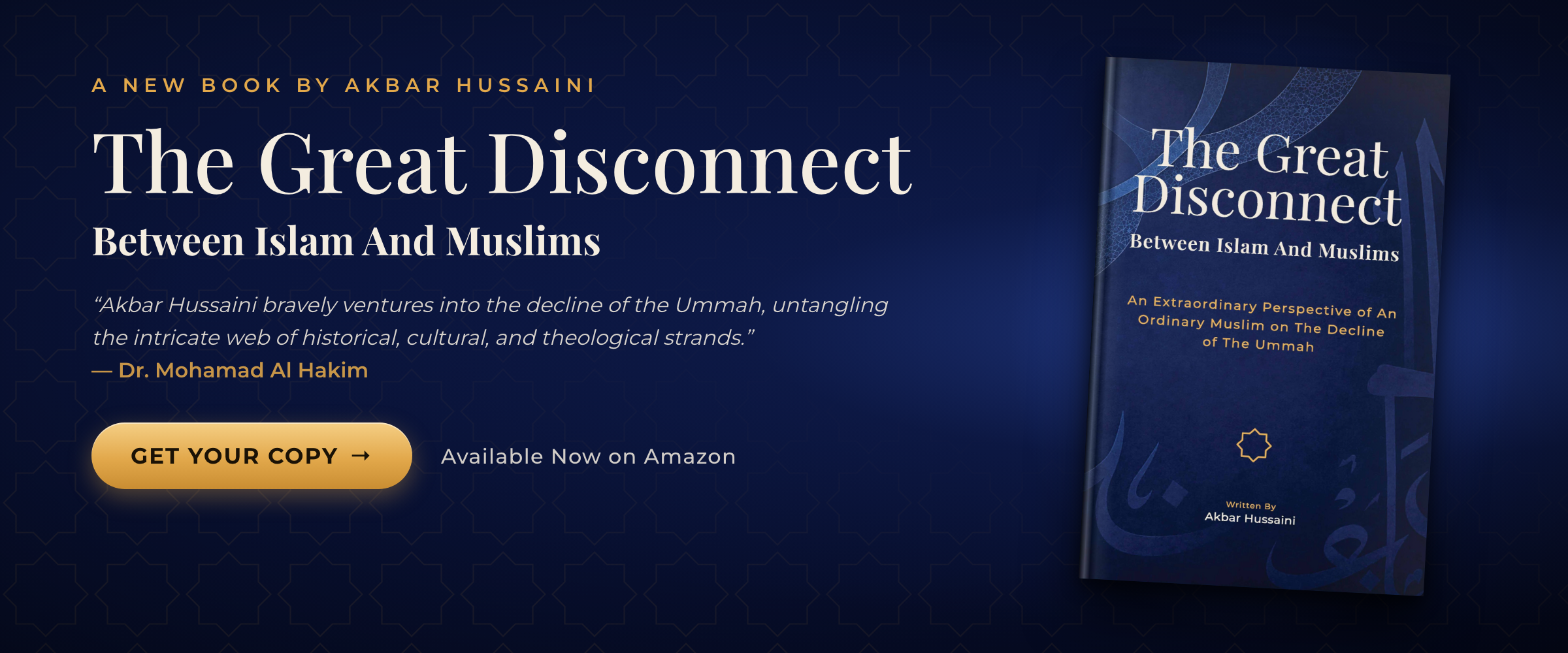
I was doing well in the US with a new family and a new business of my own. I was completely preoccupied with these two things when 9/11 happened, and there I was again, fighting uphill just because my name sounded Muslim. The event and its aftermath for my community forced me to investigate my identity and my religion.
Upon studying the religion and then comparing it to other religions, I realized that for me there is no better and more logical religion than Islam. However, I also noticed that Muslims in general do not know about their own religion in the true sense. They only hear bits and pieces from the Imam or the Alim. They combine these bits and pieces with their own perspectives and the way they were raised as Muslims to form their personal understanding of Islam.
If they ever want to ask questions to connect or fill the gaps between these bits and pieces, they are reprimanded. When they want to study the word of God, i.e., the Quran, by themselves, they encounter a language barrier. That language barrier is not just for the non-Arab Muslims, but it is also for the Arabs because the Arabic used by the Quran is Classical Arabic, which is very different from the spoken Arabic they grew up with. If an enterprising Muslim wants to study the Quran, they are told that there are inaccuracies in translations, which I confirmed later to be the case. But to get a surface-level understanding of the Quran, it is better to read translations than to abandon the pursuit of understanding what Allah says in His only guide to humanity.
However, we Muslims chose to outsource the responsibility of learning about our Deen of Islam to professionals, who quickly assured us that they were the only ones qualified to understand and interpret Islam. Thus began the process of corruption of the true essence of Islam, and slowly a Deen emerged that only faintly resembled the Deen of Islam as taught by the Prophet Muhammad SAWS. There were other historical and theological factors that contributed to the decline of the Ummah. My analysis and conclusions were reached after years of studying the history of Muslims.
Then I did the obvious thing, which was to find how many books have been written about this topic and how many of them agree with my investigation and assessment. I found that there were a few books which reached similar conclusions, but the predominant tone in most of these books was that of tiptoeing, equivocating and hedging. They reached similar conclusions but obscured the causes rather than identifying them clearly. Either they want to be diplomatic and avoid blaming a person or a group of people, or they are themselves not clear about the main cause of the issues faced by the Ummah through its history.
I believe that ambiguity leaves the reader very confused or even frustrated. Studying history, especially when trying to identify the causes behind the decline of the Ummah, requires clarity and a high degree of certainty. This is not to lay the blame on one or more people but to thoroughly diagnose what went wrong with the Muslims.
Defining the problem with clarity is the first important step in coming up with the solution. Without that definition, our solutions would only be based on speculative guesswork and weak assertions. I am sure there is a degree of conformity that is involved along with fear of blaming the very people who could be offended and lash out at the author. These authors may themselves be afraid of risking their acceptance in the circles of professionals who thrive on traditionalism as opposed to rational thinking and questioning.
I quickly realized that, being an ordinary Muslim, I had nothing to lose and could afford the displeasure of some narrow-minded professionals. My goal was to define the problem as accurately and clearly as I could so we, the Ummah, can then tackle the next step of finding the solution which will get Muslims out of this state of degeneration. I know some may think that I am too direct, simplistic and non-diplomatic in my examination and evaluation.
I purposefully chose that tone to startle our desensitized Ummah out of our slumber. We have become numb to genocides, war crimes, blatant abuse and corruption everywhere. An obscure or ambiguous hint will not penetrate the insensitive heart we seem to have developed. I wanted to write a book that is as direct as it can be with a prickly tone that will force us to sit up and pay attention.
This is a book that, despite its share of barbs and spikes, is based on research and verifiable facts of history, philosophy and theology. I have tried my best to not mention specific names for the most part, whether those are contemporary or historic. I am not interested in placing blame but in pointing out the words and actions along with their consequences. I follow the Islamic guidance of blaming the sin and not the sinner. I recognize that no human can be perfect. That also means that no human can be perfectly good and incapable of doing any bad or perfectly bad and incapable of doing any good. I have resisted the simplistic tendency of making people into infallible saints or evil sinners. I also wrote this book to express the thoughts of many decent and wise ordinary Muslims who agree with most of the analysis but have not had the time or the opportunity to write a book. My sincere hope is that it resonates with many of these common Muslims and that they will join the movement to find solutions for the Ummah.


 Where Do You Go to Learn About Islam? - Light Upon Light by IslamiCity - Ep...