
IslamiCity
Listen PodCasts, Live Quran, Watch Videos @VideoHub

Some consider al-Andalus (Islamic Spain), with its rugged peaks and plush river valleys and endless expanse of olive groves and fruit orchards, to have been paradise lost. For others it was a high point of Muslim achievement in the sciences, philosophy, and the arts. Still others consider it the epitome of a medieval pluralistic society where Muslims, Christians and Jews shared a common culture and created a unique and humane society for nearly 800 years.
Muslims conquered the Iberian peninsula in 711 CE, under the leadership of the famous Berber general Tariq ibn Ziyad. With the establishment of the Abbasids in the east around 750, al-Andalus proclaimed independence under the leadership of Abd al-Rahman I, a young prince of the Umayyad household. Thus, from the outset, al-Andalus began to formulate its own unique identity as part of the larger panoply of Muslim territories. Contributing to this was the fact that indigenous Hispani-Romans assimilated to the Arabic culture, and while some remained Christians or Jews, a great majority embraced Islam as their religion. Qurtubah (Cordoba), the Umayyad capital, became famous as a center of administration and learning, giving birth to such eminent figures as Ibn Hazm and Ibn Rushd, Ishbiliyyah (Sevilla) was renowned for its handicrafts and poetic flair, and Tulaytulah (Toledo) was a city where scientists such as al-Zarqali gathered to study the stars and formulate advances in mathematics. After 1250, Gharnatah (Granada) stood as the last Muslim kingdom against the encroachment of increasingly powerful northern Christian kingdoms, and shone in a brilliant effervescence of architecture, literature, music, artisanship, and religious scholarship. The sad and tragic conquest of Granada in 1492 by the Catholic monarchs Isabella and Fernando represents one of the watershed events of Muslim and world history, causing us to reflect on the vicissitudes of time and impermanence of human endeavors.
Yet the loss of al-Andalus, while lamentable, can serve an important and noble purpose. It is a reminder to Muslims and others today of what Muslims are capable of, if they have Allah's favor and if they strive to implement the teachings of Islam that engender strong and vibrant societies. The ideals of freedom of thought, religious pluralism, gender egalitarianism and opportunity, consultative leadership, and education that bind religious instruction to practical knowledge, have been manifested to certain degrees in various ways in past Muslim societies. Muslims today, rather than simply pointing proudly to the achievements of the past vis a vis other past societies and believing that their work is done because "Islam is the solution", must grapple with contemporary realities and be progressive and innovative in applying the rich source material of the Qur'an and Sunnah to formulate a "new al-Andalus" in Muslim lands that expresses these ideals in new ways and that takes a rightful place of leadership in the modern world.
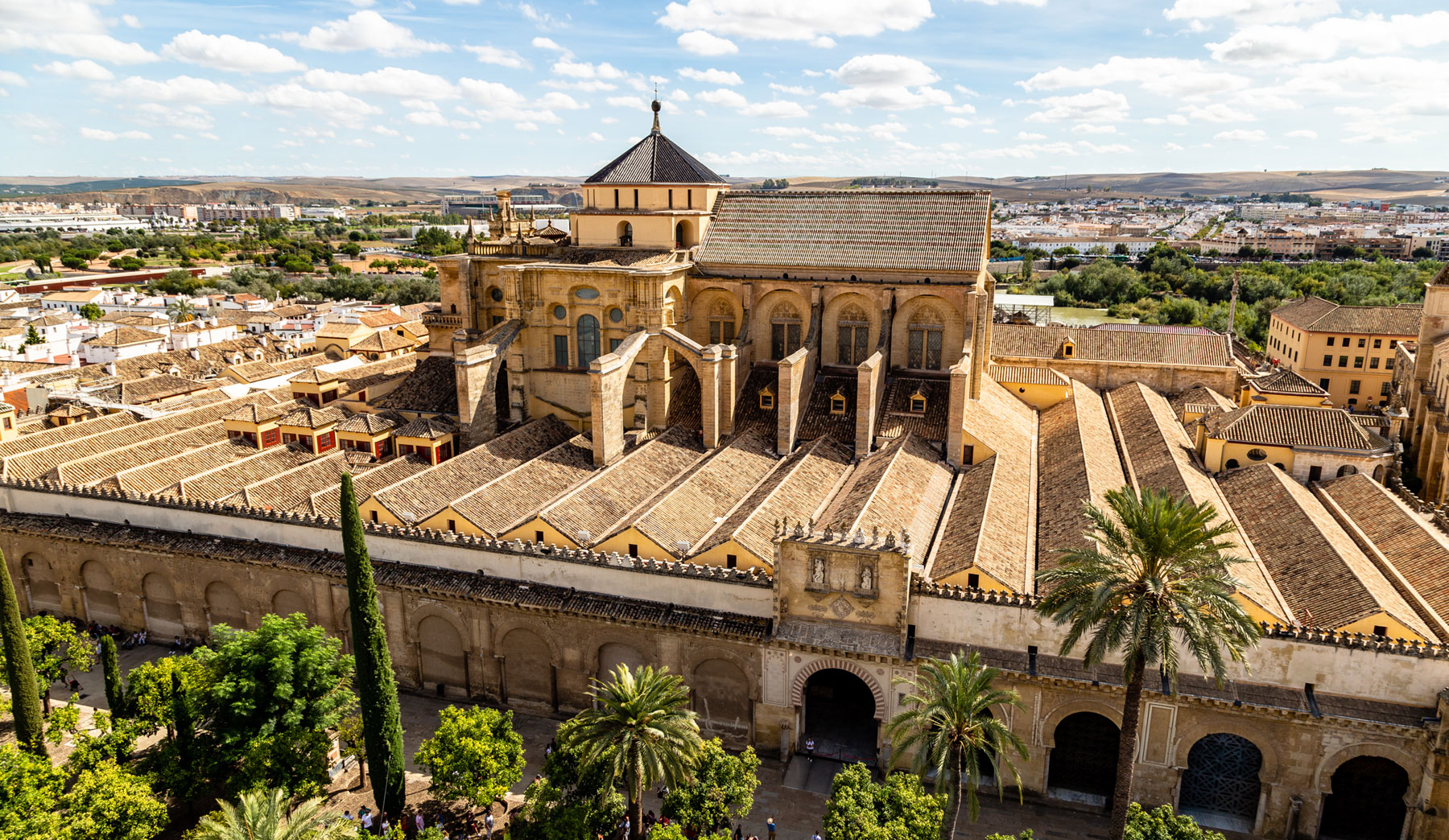
| Learn more about the historical al-Andalus, by joining IslamiCity's 8-day tour to Southern Spain, April 20-28, 2002. The tour is being led by Munir Shaikh, a PhD student at UCLA who specializes in the history, culture and architecture of al-Andalus. You will visit the cities of Madrid, Toledo, Cordoba, Sevilla and Granada, and explore the famous Umayyad Masjid of Cordoba, the Alcazar in Sevilla, and the Alhambra palace in Granada. You will also meet with local Muslims living in Spain and pray Jumah at a masjid in Granada. This is an educational and fun trip that you don't want to miss. For more details and cost, please visit: www.islamicity.com/travel/spain or you can call (310) 642-0006 Ext 202 (USA Phone number, Pacific Time) |  |
 Islam in Spain


