
IslamiCity
Listen PodCasts, Live Quran, Watch Videos @VideoHub

In the war between terrorism and ignorance we have seen torture and "collateral" slaughter carried out by government associated military personal on one side and the grotesque killings carried out by people unaffiliated with any government who behead their victims and commit acts of violence on the innocent on the other side. Such actions overwhelms and challenges our humanity to the core.
The people who carry out the torture and collateral mayhem are accountable to the laws and politics of their countries and will be treated accordingly.
The people who commit the gruesome killings and acts of violence on innocent civilians do not consider themselves accountable to anyone but they forget that they are accountable to a much higher authority - God! And they will face justice by Him.
To associate these people with any religion would be an insult to that faith. There is no religion that promotes such vicious behavior. God has made it quite clear in the Quran that anyone who kills an innocent person it is as if the person has killed the entire humanity.
While the Geneva Conventions spelled out explicit guidelines for treatment of war prisoners in the 20th century, Islam established specific rules and regulations regarding prisoners 1,400 years ago.
Islam stands against waging war, especially against the innocents. At the same time it recognizes the possibility that humankind may resort to war against each other. Which is why specific rules have been established to regulate warfare.
In Islam war is allowed when other nations have attacked a state or if another state is oppressing its people. Under Islamic law war should be conducted in a disciplined way, so as to avoid injuring non-combatants and extending humane treatment towards prisoners of war.
A recorded example of Prophet Muhammad shows us the compassion he showed for a war prisoner when he saw a prisoner without a shirt, the Prophet removed his own shirt so a war prisoner could be clothed.
The Quran stipulates, "Fight in the cause of God against those who fight you, but do not transgress limits. God does not love transgressors." Quran 2:190
This verse outlines the rules of engagement. Material interests should not be the motivation for waging war. People involved in fighting should not resort to unscrupulous methods or indiscriminate killing and pillage, which characterized the wars of the pre-Islamic era. The excesses that this verse points to are acts such as harming women and children, the old and the injured, mutilation of dead bodies, unnecessary destruction of fields and livestock ... such acts of injustice and brutality are considered transgression.
The greatest example of humility in war was shown to us by Prophet Muhammad when he returned to Makkah after eight years when he left after considerable harassment by the Quraysh of Makkah.
With an army of ten thousand the Prophet converged on the city. The Quraysh realized that there was no hope of resisting the Muslim forces. The Quraysh had persecuted the believers, tortured and boycotted them, driven them out of their homes, made war on them, and killed many. Now they were apprehensive about their fate.
If the Prophet wanted revenge it was easy. But revenge was not his object. He did not lead his army into Makkah like a tyrant, full of arrogance, forgetting the Almighty.
An early biographer describes that when the Prophet entered Makkah it was with great humility and gratitude. He declared an all-embracing amnesty and peace, in place of any thought of avenging past material or mental afflictions, demonstrating what God wills of Godly men: "... enter the gate prostrating and say 'Amnesty'." (The Quran, 2:58; 7:160).
The Islamic ethics of how a Muslim should conduct a war is also recorded in history when Salahdin in 1187 C.E. recaptured Jerusalem.
When Salahdin entered the city he was touched by the plight and pitiful living conditions of the common people. Salahdin graciously granted freedom to all aged Christians. He also released husbands and fathers of the freed Christian women. All buildings were left intact. He even permitted the Jews and Orthodox Christians already living in the Holy City to stay. When asked if the Christians' sacred places be returned to them, he agreed.
Salahdin extended these terms even though Muslims and their places of worship had been violated by Christians. Salahdin prohibited acts of vengeance, and his army was so disciplined that there was no bloodshed after the city surrendered.
The history of human civilization is filled with examples of violent cruelty. In the past, sadism as we see in the news today was limited to the ill-fated people who experienced it or the unfortunate people who directly witnessed it. But now in the age of electronic media these images of unimaginable brutality are being broadcast to the entire world. Vicious emotions are being instigated on all sides.
As we slide down the slippery slope of occupation and resistance, war on terrorism to war on injustice we are seeing human civilization being pushed towards more anarchy.
If we are to avoid the path of perpetual war and destruction, we need to ask our selves if we should use Religion to divide ourselves or should we use it to explore our common humanity? Do we use Religion to perpetuate social injustice or do we use our common values of social justice as embedded in our religion to eliminate oppression, poverty, racism, illness, and sexism? Should we use Religion to preach Hate or Love?
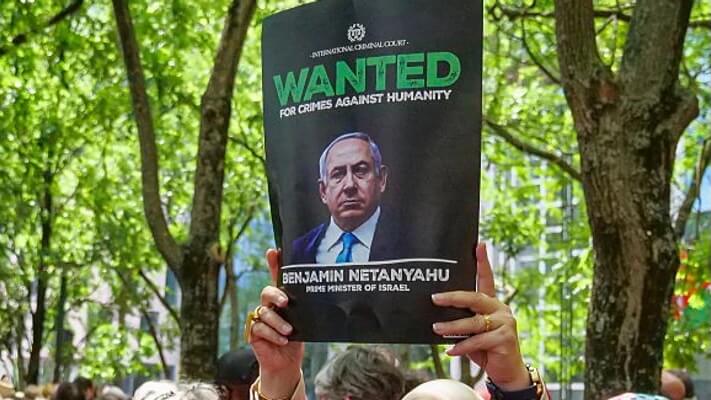 Stop Netanyahu Before He Gets Us All Killed


