
IslamiCity
Listen PodCasts, Live Quran, Watch Videos @VideoHub

According to Arab News (Jeddah, January 15, 2005), Sheikh Abdul Rahman Al-Sudais, the imam of the Grand Mosque in Makkah has urged Muslims to unite to alleviate suffering of Muslims worldwide. I appreciate this call as it speaks to the hearts and minds of Muslims everywhere. Unfortunately, however, his country's decisions are inadvertently doing just the opposite-dividing Muslims even on the matters of worship in which there is universal agreement.
I am referring the recent Saudi decision to change the Day of Arafat (the main day of the Hajj) as well as the day of Eid ul Adha (Festival of Sacrifice) and the rift and pain it has caused among Muslims who desperately want to unite, specially on the main days of worship.
Here in the USA, based on reports from the Saudi Hajj authority and the Moon Sighting Committee of the Islamic Society of North America, it was declared that January 12, 2005, would be the beginning of the Zul Hijjah (12th month of the Hijri calendar), and accordingly, Eid ul Adha would be celebrated on January 21, 2005 (Friday).
On January 14, however, the Saudi authority surprised everyone by announcing that the Day of Arafat would be January 19 and the Eid ul Adha on January 20. The Saudi authority reportedly advanced the Eid celebration by one day based on moon sighting claims by two persons on January 10. But astronomical data make their claims clearly incorrect.
As reported in www.Moonsighting.com, on January 10 it was impossible for anyone to see the new moon anywhere on earth except possibly in Chile and Polynesian islands. The new moon was born at 12:03 Universal Time on that day and was barely 3 hours old in Saudi Arabia where it set 3 minutes before the sunset.
Put simply, if a trace of the new moon is sighted in Saudi Arabia, we in the North and the West coasts of the U.S. should be able to have a better view of that moon because we are ahead of the Saudis in its growth trajectory. Nobody has reported sighting the moon on January 10, 2005 anywhere on earth. So, ISNA has found the Saudi moon sighting report erroneous and stuck to its earlier decision to celebrate the Eid on January 21.
But many American mosques are ignoring the ISNA decision and following the Saudi decision ironically in the name of global Muslim unity.
I have noticed since the early 1990s how decisions on Ramadan and the Hajj dates taken in Makkah divide and create conflict among Muslims in the U.S. A few years ago we celebrated the Eid ul Fitr over three days during which we experienced an unnecessary cold war within the community. After that, for several recent years, ISNA followed the Saudi decision in the interest of unity among Muslims. Later on, ISNA realized the imprudence of that decision.
The imprudence is that those who claim to have sighted the moon well ahead of its astronomical visibility (established by credible astronomers) are either lying or making a mistake. This is what an eminent Egyptian-American Muslim astronomer pointed out at a Southern California MAYA (Muslim Arab Youth Association) conference a few years ago, after demonstrating the scientific determinism with which astronomers can predict the movement cycle of the moon.
This is not the first time the Saudi authorities have unilaterally declared the date of the Yaomul Arafah (the Day of Arafat) and the day of Eid based on astronomically incorrect reports of sighting the moon. In fact the Saudis are almost always one day ahead in declaring the Ramadan, Eid ul Fitr, or Eid ul Adha.
Those who accept the Saudi decision without critical reflection argue that the Eid has to be celebrated worldwide on the day after the Day of Arafat. But throughout the fourteen hundred years, until the late 20th century, Muslims in the rest of the world, even those who lived just a couple of hundred miles away in Medina, did not hear from the Makkans about the exact day of Arafat or the Eid. They determined that day and celebrated the Eid, as the Prophet (SA) instructed, based on their own local sighting of the crescent moon. This tradition of the Eid celebration is still in place in the many Muslim countries. Muslims in Bangladesh, for example, are celebrating this Eid on January 22, 2005 (Saturday), two days following the Saudi celebration.
Today technology has brought us physically closer together. We watch the performance of the rites of the Hajj as they take place in Makkah on live video feeds and feel inspired to synchronize our celebration with the Makkans'.
The Saudi authorities who make the key decisions and those who follow them have to keep in mind that their actions are drifting the already fractured Muslim community further apart.
There is a way out of this mess we are in, and that is called shura or consultation in Islam. The Saudi authorities have to consult the voices of reason-international Muslim scholars and scientists-before repeating these mistakes and thus further creating discord among Muslims.
Mohammad Auwal is associate professor of Communication Studies at California State University, Los Angeles
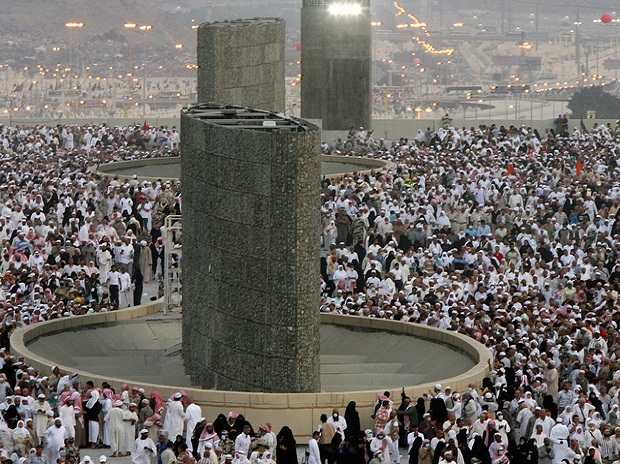 Hajj: The Battle Front at Mina


