
IslamiCity
Listen PodCasts, Live Quran, Watch Videos @VideoHub

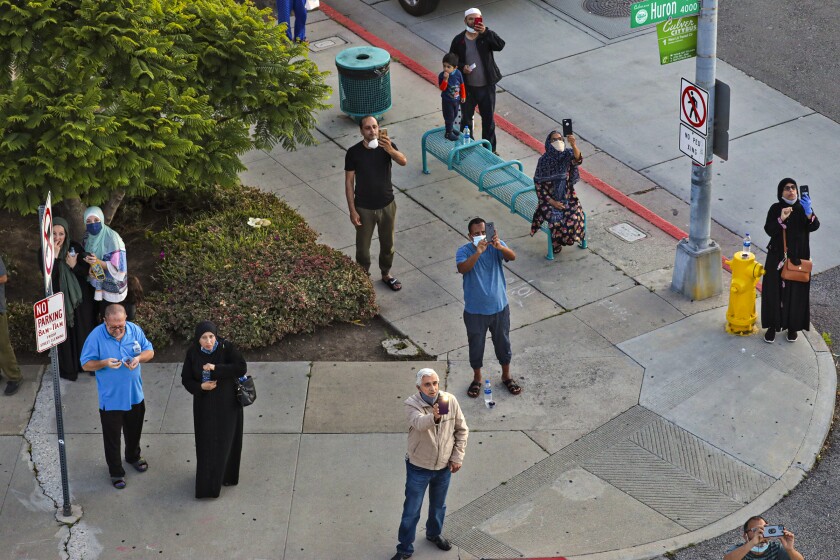
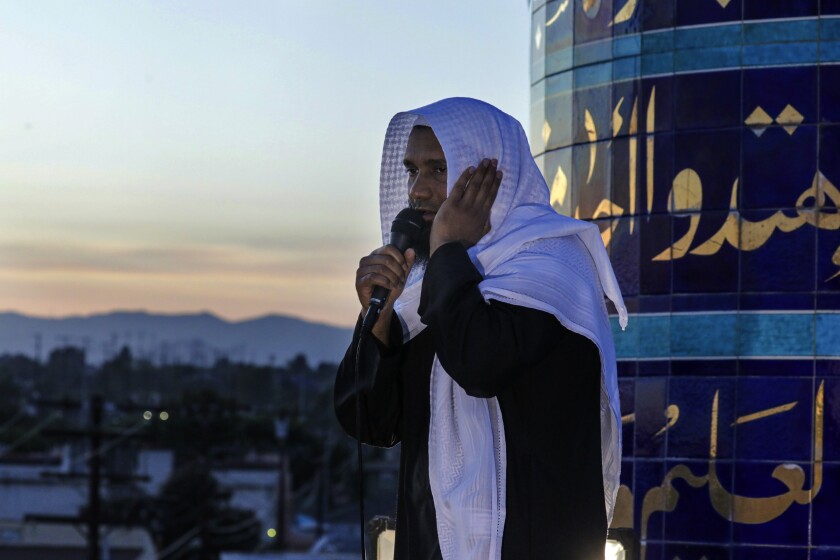
The call to prayer rang out at 7:49 on a Saturday evening as the sky glowed pink from the setting sun.
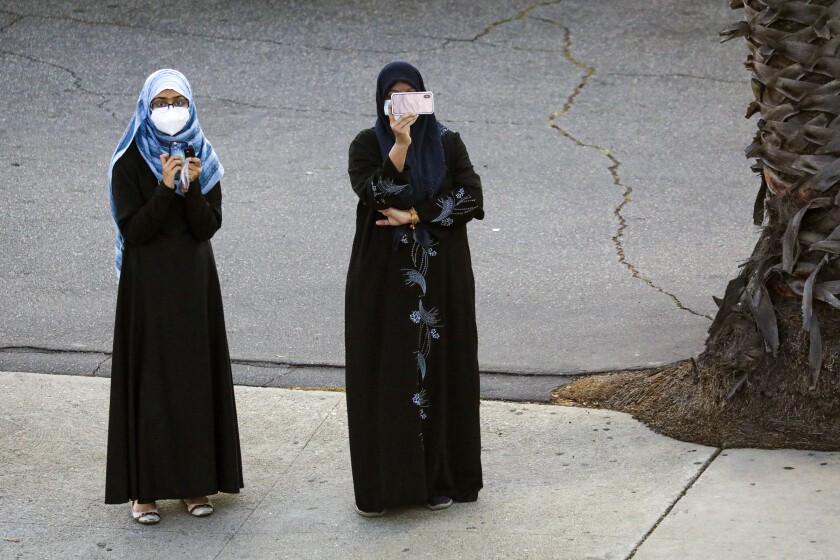
Women in hijabs and masks gazed up at the mosque as the Arabic hymn floated down:
Allah is the greatest.
I bear witness that there is none worthy of worship except Allah.
Mahmood Nadvi stood on King Fahad Mosque's roof, 60 feet above the street, nearly level with the palm trees, singing into a handheld microphone.
For over 1,000 years, Muslims have relied on the human voice to call the faithful to prayer. It's become tradition that wherever a mosque is built, there is a place for the muezzin, or prayer caller, said Aslam Abdullah, a Muslim scholar based in San Bernardino.
While the adhan echoes five times a day in Islamic countries, like a Roman Catholic church bell signaling Mass, it is unusual to hear the adhan publicly broadcast in the U.S., where it is more likely to be heard in Hollywood movies.
In extraordinary times, when Muslims are unable to break the fast and pray together because COVID-19 has forced mosques to close - as it has some churches and other places of worship - the adhan has brought comfort. Cities across Southern California, including Redlands, Fontana, Rancho Cucamonga and Claremont, have allowed mosques to broadcast the call to prayer publicly.
Outside the Culver City mosque, some pedestrians stopped in their tracks when they first heard the adhan, seemingly surprised. This was something new, and it was not altogether clear how it would be received - as with many things Muslim in the U.S.
"It is indeed historical," said Abdullah, who in the last week has heard the call to prayer broadcast in Redlands and Fontana. "It's more than tolerance, it is our acceptance, I think. That's a remarkable thing that this country has shown once again."
But in Culver City, the call to prayer did not go unchallenged for long.
After four days, on May 18, the city's police department revoked the amplified noise permit, citing people congregating at the mosque in violation of the county health order, as well as "numerous loud noise complaints from area residents."
"We have had and will continue to have a great relationship with mosque leadership," said Capt. Jason Sims with the Culver City Police Department. "We are certainly happy to help with facilitating any type of service that is not in violation of county health orders."
Three days later, the city changed course again, reinstating the permit on the condition that the mosque lower the volume.
Meanwhile, on the Nextdoor social networking app, debates raged between neighbors.
"I'm glad I don't live near there," someone commented, spawning a string of responses.
"There are a lot of bitter racists in CC," someone replied.
"What has a Muslim ever done to you?" one user said.
"Make me unhappy," another responded.
Another commenter added: "You should ask people from Europe what they think about the muslims? I don't think you get many people cheering them on."
Across the U.S., the closure of churches has prompted pushback, with some filing lawsuits and a few defying stay-at-home orders.
The U.S. Justice Department warned in a letter Tuesday that the measures Gov. Gavin Newsom enacted to slow the spread of the coronavirus and his plans to unwind them might discriminate against religious groups and violate their constitutional rights.
More than 1,200 pastors have vowed to hold in-person services on May 31, Pentecost Sunday. On Friday, Trump declared houses of worship "essential" and called on governors to allow their reopening.
In the U.S., the question of whether to broadcast the adhan publicly has been controversial over the years. When the City Council in Hamtramck, Mich., approved the local mosque's request to amplify the call to prayer in 2004, it sparked anger in the town.
"With so much going on in the world with terrorism, people are afraid maybe they'll be saying things [in Arabic] that we don't understand," a bakery manager said at the time.
Despite the initial controversy, the adhan continues being broadcast there today.
Click here to read the remaining full article at Los Angeles Times.
( Source: Los Angeles Times )
**********************
Related articles on IslamiCity:Los Angeles: 'Call to Prayers' Echoes in Ramadan (May 17, 2020)
Minneapolis Neighborhood: 'Call to Prayer' Broadcast During Ramadan (April 22, 2020)
 Zakat: Its Concept and Purpose in Islam


