
IslamiCity
Listen PodCasts, Live Quran, Watch Videos @VideoHub

Many Muslims live their religious lives in a paradox, torn between nominal faith and lived faith. Believing in Almighty Allah (al-iman bi-Allah) is the fundamental tenet of Islam, referring to affirming His existence, oneness, and attributes.
However, for some, believing in Allah does not correspond to believing Him, the latter signifying absolute trust in His words and promises, obedience to His commands, and reliance on His guidance without hesitation. This paradox discloses a spiritual crisis with far-reaching ramifications for the life and thought of Muslims today.
Positively, Islam requires a transition from mere acknowledgment to trust, from declaration to obedience, and from titular faith to transformative faith. How, for example, can a believer in Allah ever place the word or authority of anything or anyone on par with Allah's-or worse, above it-when Allah explicitly declares: "Who is more truthful than Allah in statement?" (al-Nisa' 122), and "Whose word can be truer than Allah's?" (al-Nisa' 87)?
Should not Allah be recognized and embraced as Creator, Lord, and Sustainer in all affairs-both earthly and heavenly, both individual and communal? Is there anything more commanding and more piercing than His rebuke: "Do you know better than Allah?" (al-Baqarah 140)? Indeed, the response of true believers must ever be: "We hear and we obey" (al-Nur 51). This should persist as their mantra under all circumstances, whenever Allah speaks or instructs.
Yet in practice, many profess faith in Allah but, when confronted with trials, rely more on worldly means than on the clear guidelines of their Lord. Others tend to compromise the values and standards implicit in al-iman bi-Allah under the pressures of modernity, politics, economic gravities, and culture. All of a sudden, priorities are thrown into disarray, and reliance on human authority or self-confidence comes to overshadow reliance on Allah.
People should be careful, because there are many types and levels of shirk (associating others with Allah), as well as numerous paths leading to it. The discrepancies in faith described above may themselves constitute one of those paths.
The commentators of the Qur'an are unanimous that the meaning of this verse is clear: whatever Jews and Christians put forth in matters related to the supremacy of truth, as reasons for constructively interacting with you, O Muhammad, and with other Muslims, is hollow and hypocritical. They seek not belief but surrender. Even if you were to bring them every sign and grant every concession, they would still turn away. What would please them is only your abandonment of Islam and your submission to their path.
The above proclamation is not merely descriptive but forms part of an ideological and operational framework. Within it, Allah clearly instructs that believers must not take disbelievers as allies, friends, supporters, or helpers (awliya') in preference to fellow believers (Alu 'Imran 28).
He further warns that those who follow their passions and evil desires wish to lead believers astray (al-Nisa' 27); that devils inspire their allies among men-including Jews, Christians, and disbelievers-to dispute with believers (in order to confuse them and make them abandon their ways), and if believers were to obey them, they would themselves become idolaters (al-An'am 121); and that a faction of the People of the Scripture will always aim to mislead believers, tirelessly working to carry out their designs (Alu 'Imran 69).
Moreover, Allah affirms that there is neither honor, nor power, nor help except with Him (al-Anfal 10; Yunus 65). To aspire for these from others without Allah guarantees nothing but humiliation and wretchedness. Finally, Allah makes clear that He will not change the condition of a people until they change what is within themselves (al-Ra'd 11).
With this in mind, to withstand Satan's and his hosts' schemes, believers must trust wholly in Allah and His Messenger, cling to the Qur'an as their guiding constitution, and unite in brotherhood like a single body - resilient against all external assaults. The paradigm embodies the principle of living "one for all and all for one", under the overarching inspiration and protection of heaven.
This stands in stark contrast when set against the additional words of Allah, who makes clear that disbelievers cooperate and unite in all sorts of alliances as a means of working against believers. If believers fail to do likewise-forming their own bonds of solidarity to counter the prevalent axes of evil-then oppression and fitnah will spread across the earth, accompanied by great corruption (al-Anfal 73).
It is undeniable that barbarism and savagery are frequently disguised as civilization and progress, while misery and ruin are advanced under the guise of enlightenment and scientific achievement. Then again, it is only believers-the followers of the final Messenger of Allah, Muhammad (peace and blessings be upon him and his family)-who can offer hope, develop alternative paradigms, and inspire different narratives about an increasingly gloomy future. They alone stay the course, retaining not only spiritual but also existential normalcy. They are the only truly "normal" lot around.
That is why Allah calls them the best and most just ummah-a designation that is a responsibility rather than a privilege. On the Day of Judgment, they will either stand as witnesses against humanity, should they live up to their calling, or the Prophet himself will be a witness against them, should they fail to fulfill the trust (Alu 'Imran 110; al‑Baqarah 143).
It is precisely because of this role that the forces of falsehood, malevolence, and sin are ever mobilized to incapacitate the community of believers-the ummah-and to prevent them from performing their duties freely and unhindered. These forces ceaselessly invent schemes against believers, trying to keep them under control. They are more concerned about believers than about themselves; in reality, they know believers better than they know their own sons (al‑Baqarah 146).
This explains the ubiquitous presence of Islamophobia, crusades of empire and crusades of ideology, the endless campaigns of "fighting terrorism," the forced democratization of the Muslim world-particularly the Middle East-the so‑called "mission to civilize" Muslims, and the creation of the pseudo‑science of Orientalism to confuse and misguide both Muslims and non‑Muslims. It explains the deliberate impoverishing, de-civilizing, and de-culturalizing of Muslim nations, followed by the endless offering of "help" and "assistance" that are little else than poisoned chalices.
From the very beginning, all satans-whether from among jinn or mankind-have been set upon believers. Their goals have remained consistent: to baffle, misdirect, divide, conquer, subjugate, and ultimately destroy. Nothing has changed from the cheap plots of Satan against Adam and his wife in Jannah to the modern campaigns spearheaded by the Judeo‑Christian West.
Anything is tolerated, celebrated, and accepted except being a Muslim. Every atheistic absurdity, every polytheistic delusion, and every form of self‑worship is granted legitimacy. The Oneness of Allah, though, which alone generates the coherence of faith and the purity of morality, is spurned.
Ugliness is placed upon the pedestal of beauty, promiscuity and impurity upon that of chastity, anarchy and servitude to Satan and animal desires upon that of freedom and self‑respect, and stealing, lying, and cheating upon that of virtue. A single crime against a single person is rightly viewed as a crime, yet collective, national crimes against fellow nations are celebrated as patriotism and praised as smooth, creative operations. They connote strategy and ingenious statecraft.
Frankly speaking, all this makes sense, given that Islam and Muslims are duty‑bound to expose distortions and lies-whether historical, ideological, or religious-and to fight them tooth and nail, relentlessly bringing their protagonists to task. Only on account of Islam and Muslims are falsehoods discredited, dismantled, and kept at bay. Hence, Islam and Muslims stand as the thorn in the eye of those who thrive on dishonesty and fraud, the living reminder that truth cannot be silenced.
However one tries to put it, it does not fade from clear view that the overwhelming sections of the institutionalized West were born to be, and never ceased to operate as, a wolf in sheep's clothing. Carrying in its veins the genes of Rome-the official foundation of Western (un)civilization-which, by the way, was the most violent and most destructive empire in human history, the West prides itself on being the inheritor. Whatever it does, even when it appears good, must contain elements of negativity and marginalization of the "other," the non‑Western sections of humanity. They simply cannot think or behave otherwise.
Such is life's destiny, and both Muslims and the rest must accept it and live on. Life itself is but a trial, a prelude to the Hereafter, not an end in itself, nor a playground to be enjoyed "to the fullest," nor an experiment in utopia. Its meaning lies in preparation, in struggle, in truthfulness, and in fidelity to the One.
These are realities one must accept and coexist with, without compromising who he is or what his life mission and objectives are. The same applies to both ends of the spectrum, though. If Muslims are expected to live and coexist with the West and its not‑so‑innocent proclivities, then the West must equally learn to coexist with Muslims. The Islamic way is clear: "To you your religion and way of life, and to me mine" (al‑Kafirun 6).
If people are honest and sincere, there must be ways and platforms for cooperation and moving forward. Islam offers plenty of leeway and opportunities, grounded in the principle that humanity is a family-brotherhood in creation-sharing the unity of existence, origin, and purpose. Humanity's destiny is everyone's trademark, and the shared imprint of creation itself.
As the religion of compassion and mercy, Islam has something for everyone. Its "heart" is vast enough to accommodate all, at least in principle and preliminarily, provided they are compatible with Islam's universal character, which is consistent with the humanness of man and the naturalness of the world. Moreover, "There is no compulsion in religion; verily, the right path has become distinct from the wrong path" (al‑Baqarah 256). Let people enjoy and share the privileges of freedom, equality, and justice, after which Almighty Allah will sort them out on the Day of Judgment. Clear‑cut and overly judgmental sorting out is not to be carried out in this world.
Neither Islam nor its believers are inherently against Jews, Christians, or disbelievers, nor against the West itself. Rather, Islam rejects and wages wars against popularized falsehood and institutionalized corruption and aggression. In fact, Islam opposes these evils regardless of who perpetrates them, even if they be Muslims themselves. Islam is blind to artificial labels, colors, standards, and classifications. Its concern is with absolute and divine benchmarks, revealed from heaven and entrusted to earth.
Islam seeks the essence behind words, the reality behind claims, and the purity behind actions. Truth without substance is futile, and substance without truth is corrupt. Islam will never tolerate the adventures of humanizing God and deifying man, nor desacralizing life while sacralizing desires and fantasies.
Nor does this insinuate that all dealings and cooperation with the West and its ideological or religious denominations are impossible or unwelcome. Not at all. Engaging in worldly affairs on equal footing, as equal partners, and for the sake of common good from which all benefit, is not only possible but as well sanctioned and invited by Islam.
The Qur'an is clear: "Allah does not forbid you from those who do not fight you because of religion and do not expel you from your homes-from being righteous towards them and acting justly towards them. Indeed, Allah loves those who act justly. Allah only forbids you from those who fight you because of religion and expel you from your homes and aid in your expulsion-that you make allies of them. And whoever makes allies of them, then it is they who are the wrongdoers" (al‑Mumtahanah 8-9).
This definitely means that believers are simply being pragmatic, seeing things and events as they truly are, and developing behavioral models accordingly. The triad of Islam, history, and compelling reality teaches them about the nature and modus operandi of the Judeo‑Christian West. It is therefore only logical that they should deal with it in ways that preserve their dignity and well‑being, and immunize themselves against the West's unholy programs and globalized currents. To behave otherwise would be surprising, foolish, and un‑Islamic.
It is like living in a world with climatic and geographical disadvantages, dangerous animals, viruses, and other potential disasters. We do not strive to eliminate them-which would be impossible and untoward-nor do we integrate ourselves fully into them and live as if they were harmless. Instead, we capitalize on whatever advantages are available, however small, and mitigate the disadvantages, however many and great. No matter the dangers entailed, we leave nothing to chance; we always strive to be masters of our fate.
The point is that Muslims must bear the blame first and foremost. But the truth remains: devils never sleep, and vultures never cease circling above vulnerable prey. Those beginnings merely shifted from one dimension of Western iniquity to another, and from one defeat and humiliation of Muslims to the next. What we witness today-the Gaza genocide and the systematic destruction of whatever Muslim nations have managed to conjure in the past century, Iran being the latest target-is the culmination of Western barbarity against Islam and Muslims, set in motion centuries earlier.
Will we ever learn who is who, what is what, and what we are truly supposed to do? What more is needed to comprehend that the majority of the institutionalized West-regardless of how it projects itself-is opposed to Islam and Muslims? Its institutions, universities, centers of excellence, media establishments, places of worship, and pop culture are complicit in wrongdoings. They all carry the blood of millions of innocent Muslims on their hands.
They will never change, for they only want more, so long as we remain true to ourselves, our Islam, our history, our identity, and our future prospects. Our only "crime" is being ourselves and refusing to partake in their degeneracies. Unfortunately, in a world ruled by criminals, there is ever less space for insistence on identity and moral integrity. It is no exaggeration to say that even organized mafias would be proud of such rulers, for their methods rival those of the darkest underworld.
We must awaken from the slumber of colonialism. The mind must be decolonized, the soul liberated. Relations with the West must be redefined and recalibrated in the interests of truth and the future. We must understand that CNN, BBC, Fox News, Sky News, and their ilk are not sources of information but of misinformation; they are outlets of lies and prejudice against Islam and Muslims.
Similarly, Western universities-whose reputations are artificially inflated and marketed for deception-are not places for Muslim youth. Adequate alternatives must be urgently pursued. Sending our youth there only poisons their minds and perpetuates vicious circles of dependency and disorientation. What is presented as excellence is, in truth, a machinery of assimilation, designed to sever them from their faith, values, and history.
Everything that comes from the West must be taken with reservation, never for granted, against the backdrop of persistent betrayals, deceptions, and crimes. We owe this to the innocent victims, and to our role as Allah's vicegerents on earth and the best ummah, tasked with rescuing and leading the world. If not, hard questions will await us on the Day of Reckoning.
Our inaction and blind following can even be interpreted as complicity in Western rampant mischief across the globe, contributing to more slaughter, more genocide, more concentration camps, and more corruption. Certainly, nobody wants to be associated with such a legacy.
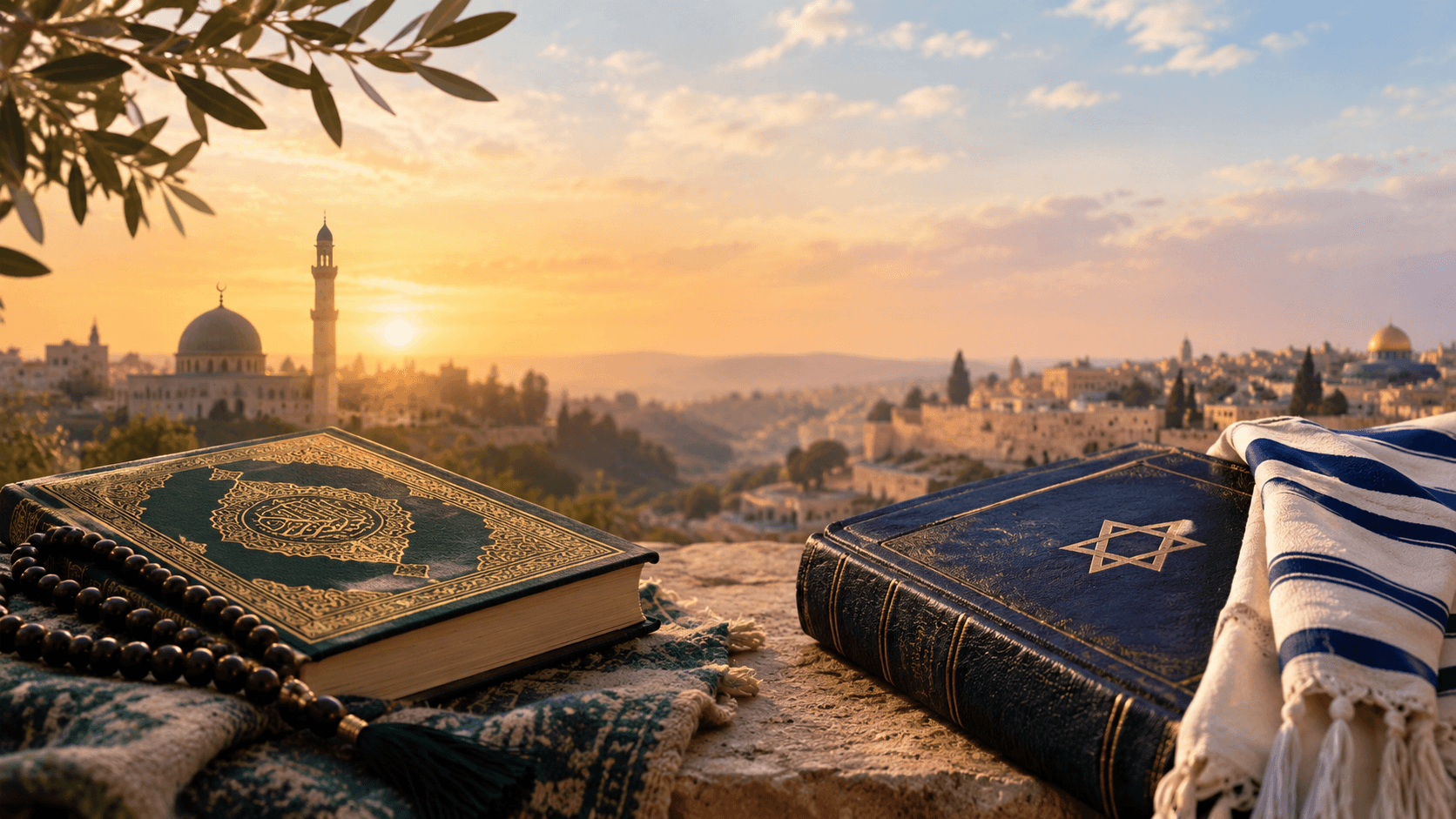 99 Names Of Allah and 70 Aspects Of YHVH God


